

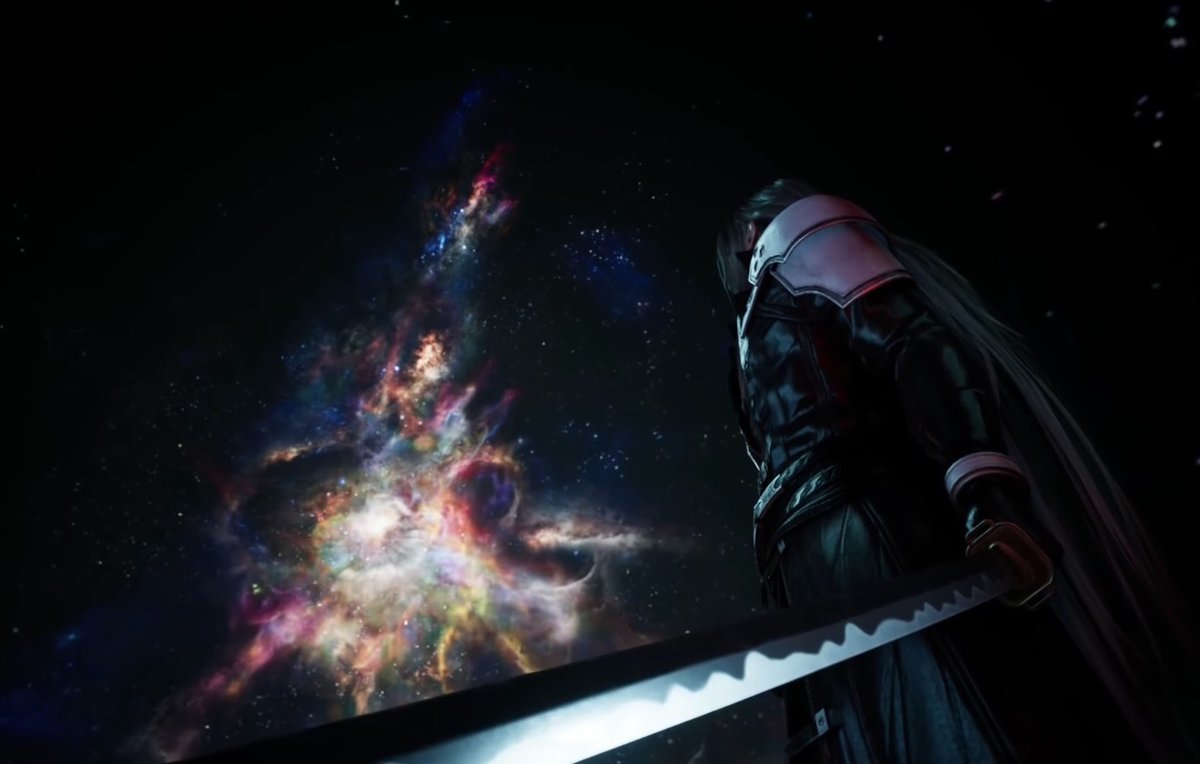
The Sephiroth who confronts Cloud at the Edge of Creation is officially categorized as “Unknown” in Square Enix’s FF7 Remake Ultimania guide – explicitly distinct from hallucinations, memories, or Jenova-controlled clones. This designation, combined with a deliberate Japanese pronoun shift noted by developers, confirms that something fundamentally different is happening with this version of Sephiroth. However, the developers have intentionally left his exact nature mysterious, fueling one of the Remake trilogy’s most debated questions.
For FF7 veterans, the key revelation is this: the Remake trilogy operates on a confirmed multiverse structure where Sephiroth exists as a transcendent being capable of influencing multiple worlds simultaneously. Whether this represents time travel, Lifestream manipulation, or something else entirely remains deliberately ambiguous – but the Edge of Creation Sephiroth appears central to understanding whatever Sephiroth’s master plan truly is.
What happens at the Edge of Creation in Remake
The Edge of Creation appears at the conclusion of Chapter 18 (“Destiny’s Crossroads”) after the party defeats the Whisper Harbinger in the Singularity. During Cloud’s subsequent battle with Sephiroth, he’s transported alone to this location – it is a barren wasteland against a starry void. Co-director Motomu Toriyama confirmed in the Material Ultimania Plus that this is “the edge of space and time where time stands still; if time were to resume, the world would end in seven seconds.”
The complete canonical dialogue reveals Sephiroth’s unusual tone and request:
Sephiroth catches Cloud as he falls: “Careful now. That which lies ahead… does not yet exist.” He then offers what sounds almost like protection: “Our world will become a part of it… one day. But I… will not end. Nor will I have you end.” Then comes the pivotal ask: “The edge of creation. Cloud, lend me your strength. Let us defy destiny… together!”
Cloud refuses and attacks. After a brief swordfight where Sephiroth clearly holds back (notably fighting right-handed despite being left-handed), he delivers the cryptic closing line: “Seven seconds till the end. Time enough for you. Perhaps. But what will you do with it? Let’s see.” He then vanishes, leaving only a black feather.
The in-game quest menu explicitly describes this as “a vision of the planet seven seconds before its demise” – though what demise and which timeline remain deliberately unclear.
The official “Unknown” designation changes everything
The FF7 Remake Ultimania categorizes every Sephiroth appearance into four types: Illusion (only Cloud sees him), Black-Robed Man (physical clones like Marco), Flashback/Recollection (memories), and crucially, “Unknown” (marked with “?”) for every appearance from the point he invites the party to breach fate’s wall onward. This official designation confirms the Edge of Creation Sephiroth is canonically distinct from the illusory Sephiroth tormenting Cloud throughout Midgar.
The Ultimania also highlights a linguistic detail that Japanese players noticed immediately: at the Edge of Creation, Sephiroth uses the pronoun “ore” (俺) rather than his usual “watashi” (私). This matters enormously for understanding his character. In the original FF7 and Crisis Core, Sephiroth only used “ore” before the Nibelheim incident – before learning his origins and losing his sanity. After his fall, he exclusively used the more formal, detached “watashi.” The Edge of Creation Sephiroth’s pronoun choice suggests either a return to his pre-madness self or an entirely different version of the character.
The community coined the terms “Oreroth” (Edge of Creation Sephiroth) and “Watashiroth” (the antagonistic Sephiroth) to distinguish them. While these are fan terms, the underlying linguistic distinction comes directly from official materials.
Major fan theories with varying evidence levels
The “Advent Children Sephiroth” theory holds moderate-to-strong evidence. Proponents argue the Edge of Creation Sephiroth specifically has literally lived through the original FF7 timeline and Advent Children, then returned with that knowledge. Supporting evidence includes: Advent Children callbacks throughout Remake suggesting someone has future knowledge (such as “The Promised Land” theme playing during Chapter 2, though that’s an Illusion-type Sephiroth appearance); the Ultimania confirming the three Whisper bosses mirror Kadaj, Loz, and Yazoo’s fighting styles from Advent Children; the Edge of Creation battle itself featuring visual callbacks to the Cloud vs. Sephiroth finale from that film; and Sephiroth’s Advent Children line “I will never be a memory” seeming literalized by his persistence across timelines. The novel “On the Way to a Smile” also established Sephiroth cannot fully merge with the Lifestream while Cloud lives—potentially explaining why he’d manipulate timelines to change that outcome. The theory specifically applies this evidence to the “Unknown” Edge of Creation Sephiroth rather than the standard antagonistic Sephiroth appearances throughout Midgar.
The “Multiple Sephiroths” theory gained significant traction with Rebirth’s confirmation that Sephiroth exists simultaneously across multiple realities. The question isn’t whether multiple Sephiroths exist – that’s confirmed – but whether “Oreroth” represents a categorically different entity or simply one aspect of the transcendent Sephiroth’s multidimensional existence.
The “Good Sephiroth” or redemption theory remains highly contested. Evidence includes his “ore” pronoun usage suggesting sanity, his request for partnership rather than servitude, and the fact that he saves Cloud from falling off the Edge of Creation. Counter-arguments note that antagonistic Sephiroth still manipulates and murders throughout both games, and the “partnership” offer could simply be sophisticated manipulation. Ever Crisis’s sympathetic portrayal of young Sephiroth adds fuel to this debate without resolving it.
Rebirth expands the multiverse and Sephiroth’s transcendence
In Rebirth’s finale, Cloud and Zack fought Sephiroth together in a place that appears similar if not the same Edge of Creation. Director Tetsuya Nomura confirmed in the Rebirth Ultimania that when Cloud, Zack, and the party fight Sephiroth in different locations across different worlds, they are fighting the same Sephiroth. As a “transcendent being,” he can influence multiple realities simultaneously – damage dealt in one world affects him in others.
Rebirth introduces crucial new dialogue expanding Sephiroth’s goals beyond planetary conquest to multiversal domination. He now speaks of “the reunion of worlds” and a “homecoming” where dying realities return their energy to a multiversal Lifestream he intends to absorb. Key dialogue includes: “When the boundaries of fate are breached, new worlds are born” and “The planet encompasses a multitude of worlds, ever unfolding. Some quickly perish… while others endure. Yet even the most resilient worlds are doomed to fade.”
Rebirth confirms at least five distinct timelines (tracked by different breeds of the Stamp mascot dog), with all alternate timelines except the “main” Beagle universe showing a massive rift in the sky indicating imminent collapse. Critically, at Rebirth’s conclusion, Cloud alone can see this sky scar in the main timeline – suggesting he now exists partially across multiple realities.
Developer commentary reveals intentional mystery
The creative team has been carefully calculated about what they confirm versus leave ambiguous. Producer Yoshinori Kitase described wanting “the starry sky that represents the overall themes of FFVII” for the Edge of Creation confrontation. Scenario writer Kazushige Nojima confirmed he writes scenarios following “the general flow of the original story but with the assumption that the way things are presented or how events occur might be slightly different.”
Nomura’s most revealing statement about the Remake project’s philosophy came from the Rebirth Ultimania: “Aside from the original FF7, there are many spinoffs like the Compilation games and novels, and there are discrepancies between them… Additionally, he thinks that there is also another different version of FF7 inside the hearts of each and every player. The Remake Project began with the goal of bringing those innumerable versions of Final Fantasy VII together.“
This suggests the multiverse isn’t just plot device but metatextual – the different timelines may represent different versions of FF7 itself (original, Compilation, player memories) being unified.
Regarding ambiguity, Nomura stated: “The other reason is my true intentions behind adding ‘Remake’ to the title, but unfortunately I can’t explain that quite yet. Maybe I can talk about it in a few years.” And on Rebirth’s subtitle “No Promises Await at Journey’s End,” he explained his intention as “the conclusion is not the slightest bit decided.”
Community consensus versus contested interpretations
Areas where the community largely agrees:
The Edge of Creation Sephiroth IS different from other appearances – the Ultimania’s “???” designation and pronoun shift provide official backing. Sephiroth possesses foreknowledge of the original FF7 timeline, evidenced by his behavior and the Whispers’ existence as timeline enforcers. Multiple timelines exist (massively confirmed by Rebirth), and Sephiroth transcends dimensional boundaries.
Actively contested interpretations include whether “Oreroth” and “Watashiroth” represent genuinely distinct entities with different goals or one consciousness playing different roles; whether Remake is a sequel, reboot, or parallel timeline to the original; the exact nature of the Edge of Creation space – afterlife, space between worlds, or something else; and whether Sephiroth’s “defy destiny together” offer represents genuine cooperation or manipulation.
Conclusions
For FF7 veterans, the essential framework is this: the Remake trilogy operates on a confirmed multiverse where the original FF7’s events constitute one timeline among many. Sephiroth exists as a transcendent entity with foreknowledge of these events, seeking to manipulate outcomes across all realities. The Edge of Creation represents a space outside normal time where this transcendent Sephiroth – distinguished from his other manifestations by official sources – pursues goals that may or may not align with “standard” Sephiroth’s antagonism.
What we can state as canonical: Sephiroth is categorized as “Unknown” at the Edge of Creation; he uses different pronouns there; he transcends worlds; multiple timelines exist. What remains speculation: whether he’s from Advent Children’s future, whether he’s genuinely reformed versus manipulating, and what exactly he wants Cloud’s help with. Part 3 will presumably resolve these questions – but the developers have been clear that ambiguity is intentional, making definitive statements about Sephiroth’s nature premature.
Leave a Reply