• My Gaming Budget Strategy

    Games are expensive. A new release can easily cost $100, and if I’m being honest with myself, it’s way too easy to get caught up in launch day hype and impulse buy something just because everyone’s talking about it. That’s a fast track to an empty wallet.

    I’ve been thinking about how I handle game purchases, and I’ve realized there are actually several strategies I could use to avoid mindless spending. Some of them work for me, some don’t, but they’re all worth considering.

    The Strategies I’ve Considered

    Waiting for Sales The patient approach. Wait for Black Friday, Christmas sales, or PSN store discounts. Buy games at $20-30 instead of full price. Most games drop significantly within their first year anyway.

    Playing Older Games There’s a massive library of older titles still available at low prices. These aren’t just “old” games – they’re proven titles that have been patched and often available as complete editions.

    Platform Switching Moving to PC for Steam sales and cheaper indie games, or subscribing to something like Xbox Game Pass for $12/month. Building a budget PC that can last for years.

    Alternative Acquisition Borrowing from libraries, buying used copies, trading with other players, or sticking to free-to-play games.

    Being Selective Only buying 1-2 full-price games per year. Not chasing day-one releases. Prioritizing what actually matters.

    Emulation Playing retro games for free on PC with a basic setup.

    What Actually Works For Me

    I’ll be straight about this – only three of these strategies align with how I actually game.

    Waiting for sales is obvious. Why pay full price when I can wait a few months? Games don’t disappear after launch, and they’re often in better shape after patches anyway. I’ve saved money just by being patient and tracking PSN sales.

    Playing older games is something I already do. I have a backlog. Those games don’t lose value just because they’re not brand new. There are incredible titles I haven’t touched yet, available at a fraction of launch price.

    Being selective is probably the most important one. I only play games I genuinely like and intend to finish. I don’t abandon games partway through, which means I need to be careful about what I commit to. This naturally controls spending because I’m not impulse-buying games I’ll never complete.

    What Doesn’t Work For Me

    Platform switching isn’t happening. I’m on PlayStation for specific reasons – the games I want to play, the trophies I’m pursuing. PC gaming might be cheaper, but that’s not where my gaming is.

    Alternative acquisition like libraries, trading, or free-to-play isn’t my thing. I prefer owning the games I play, and free-to-play doesn’t align with the experiences I’m after.

    Emulation doesn’t fit my current focus. Nothing against it, but it’s not part of how I engage with games right now.

    Be Intentional

    Here’s what it comes down to: think before you buy. Gaming is expensive if you approach it mindlessly, but it doesn’t have to break the bank if you’re strategic.

    I ask myself: Am I buying this because I genuinely want to play it and finish it, or because of hype? Will I actually play this at launch? Is this a game I’ll remember in a year?

    Let’s say I set a budget of $400 per year for games. How would that work with these strategies?

    If I’m being selective and buying full-price standard editions at $70, that’s about 5-6 new releases per year. I’d need to be absolutely certain those games are worth it.

    If I’m waiting for sales, that same $400 could get me 13-20 games at $20-30 each. More games, significantly less money per title.

    Or I could mix both approaches: 3 must-play games at launch ($210) plus 6-9 sale games with the remaining $190. This gives me the day-one experiences I actually care about while filling the rest of my year with discounted titles.

    The point is having a plan. Knowing what I want from my gaming time and spending accordingly. Recognizing that I don’t need every game on day one.

    Factoring in Subscriptions

    Now, if I’m subscribed to PlayStation Plus at $10 per month, that’s $120 per year. That needs to come out of my total gaming budget.

    $400 total budget – $120 for PS+ = $280 left for actually buying games.

    With that $280, here’s what I can get:

    Being selective with full-price games: 4 new releases at $70 each.

    Waiting for sales: 9-14 games at $20-30 each.

    Mix both approaches: 2 launch games ($140) plus 4-7 sale games with the remaining $140. Total of 6-9 games per year.

    The subscription takes a chunk of the budget, but it also provides value through monthly games and online access. It’s part of the calculation.

    Budget Category: $337.29 Annually

    Let’s look at a slightly tighter budget. With $337.29 per year, here’s how the numbers break down.

    Without PS+ subscription ($337.29 available for games):

    Being selective with full-price games: 4 new releases at $70 each ($280), with $57.29 left over.

    Waiting for sales: 11-16 games at $20-30 each.

    Mix both approaches: 2 launch games ($140) plus 6-9 sale games with the remaining $197.29. Total of 8-11 games per year.

    With PS+ subscription:

    $337.29 total budget – $120 for PS+ = $217.29 left for actually buying games.

    Being selective with full-price games: 3 new releases at $70 each ($210), with $7.29 left over.

    Waiting for sales: 7-10 games at $20-30 each.

    Mix both approaches: 1 launch game ($70) plus 4-7 sale games with the remaining $147.29. Total of 5-8 games per year.

    Budget Category: $170 Annually

    This is a much tighter budget. At $170 per year, the PS+ subscription becomes a significant chunk of the total spending.

    Without PS+ subscription ($170 available for games):

    Being selective with full-price games: 2 new releases at $70 each ($140), with $30 left over.

    Waiting for sales: 5-8 games at $20-30 each.

    Mix both approaches: 1 launch game ($70) plus 3-5 sale games with the remaining $100. Total of 4-6 games per year.

    With PS+ subscription:

    $170 total budget – $120 for PS+ = $50 left for actually buying games.

    Being selective with full-price games: 0 new releases (can’t afford even one $70 game).

    Waiting for sales: 1-2 games at $20-30 each.

    Mix both approaches: Not really feasible with only $50. Best option is 1-2 sale games.

    At this budget level, there’s a real trade-off to consider. Without PS+, I can buy 5-8 sale games throughout the year. With PS+, I’m left with only $50 for maybe 1-2 games, relying almost entirely on the monthly PS+ games for content. The subscription essentially kills the purchasing budget. I’d have to decide: do I want the PS+ monthly games and online access, or do I want the flexibility to choose my own 5-8 games on sale?

    Final Thought

    I can maintain my gaming habit without constantly draining my wallet. The key is being deliberate about what I buy and when. Wait for sales, focus on the backlog, be selective about new releases. Game smarter, not just spend more.

    The games will still be there. The experiences won’t disappear. And my wallet will thank me for thinking it through.

  • Death Stranding Changed How I Think About Video Games

    I finished Death Stranding. I’m now working on the platinum trophy. And I need to talk about why this divisive, frustrating, beautiful game fundamentally shifted my perspective on what gaming should be.

    Let me be upfront: I understand why people hate this game. The complaints are valid – the micromanagement, the clunky controls, that BB crying directly from your controller at the worst possible moments, the repetitive delivery missions, the annoying NPCs who treat you like garbage despite you literally rebuilding civilization for them. I experienced all of that frustration too.

    But here’s the thing: Death Stranding taught me something I desperately needed to learn after burning myself out on Dark Souls, Elden Ring, and the relentless pursuit of difficulty as the ultimate gaming virtue.

    The Weight of Expectations

    Death Stranding is one of the most polarizing games in recent memory. I’ve seen people call it the worst game they’ve ever played, while others hail it as a misunderstood masterpiece. Some argue Kojima needs an editor, that his creativity produces something that’s mostly incoherent wrapped around a brilliant core idea. I’ve seen the debates about whether he’s a genius or overrated, whether the game is pretentious garbage or innovative art.

    I’d spent months tackling brutal challenges in games that demanded perfection, where one mistake meant starting over, where “git gud” was the only acceptable philosophy. I approached Death Stranding thinking it would be another test of skill, another game to conquer alone.

    I was completely wrong about what this game wanted from me.

    The Frustration is Real

    Let’s not pretend Death Stranding isn’t frustrating, because it absolutely is. Sam Porter Bridges is possibly the least athletic protagonist in gaming history. He trips over rocks. He stumbles on slight inclines. His balance is a constant battle, especially when you’re carrying 200kg of cargo trying to climb a mountain in a snowstorm.

    The micromanagement is relentless. You’re juggling cargo weight distribution, battery levels for your equipment, stamina consumption, terrain navigation, weather conditions, and the threat of BTs or MULEs. Every delivery requires planning and preparation. It’s tedious. It’s meticulous. And yes, after your hundredth standard delivery, the repetition sets in.

    The NPCs are infuriating at first. These people hide in bunkers, refuse to join the network, treat you with suspicion and hostility, and yet expect you to risk your life bringing them supplies. The Collector, the Junk Dealer, the First Prepper – they’re all varying degrees of difficult and ungrateful.

    But this is where the game surprised me.

    Understanding the Pain

    As I progressed through the story and read the emails and interviews with these NPCs, something shifted. These aren’t just annoying quest-givers. They’re traumatized people dealing with a world that ended, with personal losses that broke them, with reasons for their isolation that make sense once you understand them.

    The game doesn’t excuse their behavior, but it contextualizes it. And suddenly, making deliveries to these people wasn’t about pandering to assholes – it was about connection, about slowly rebuilding trust with people who had every reason to lose faith in humanity. That realization reframed the entire experience.

    The Story That Divided Everyone

    I’ve seen plenty of criticism about Kojima’s storytelling – that it’s weird for the sake of being weird, intentionally confusing without real substance, like someone trying too hard to seem intellectual. The pacing complaints are particularly common: everything happens at the beginning and end, with hours of nothing in the middle.

    I won’t pretend the story is subtle. Kojima beats you over the head with themes about connection, isolation, life, death, and what it means to be human. The terminology is ridiculous – Beach, DOOMS, BTs, the Chiral Network, extinction entities. The final hours are cutscene-heavy to an almost comical degree.

    But beneath the elaborate presentation, Death Stranding tackles genuinely interesting concepts. AI consciousness and what defines sentience. Life after death and what remains of us. The impact of isolation versus the necessity of human connection. The balance between extinction and continuation.

    These themes resonated with me not because Kojima presented them cleverly, but because the gameplay itself reinforced them. The entire game is about connection – connecting people to a network, connecting locations with roads and ziplines, connecting with other players through shared structures. The story may be convoluted, but its heart is sincere.

    The Revelation That Changed Everything

    Here’s what Death Stranding taught me, and why it matters: video games don’t have to be about difficulty to be worthwhile.

    I’d spent so much time with Dark Souls and Elden Ring, internalizing the idea that challenge equals value, that struggling alone proves something. I’d adopted this masochistic approach where accepting help felt like cheating, where looking up strategies meant I hadn’t really “earned” my victory. I was trying to prove something, though I’m not sure what.

    Death Stranding completely dismantled that mindset.

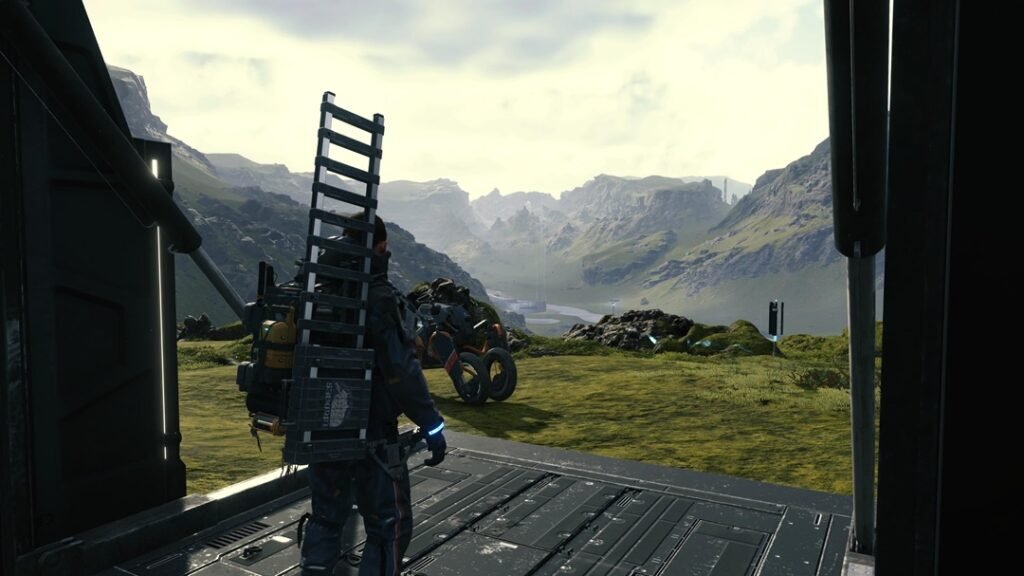
    The game actively encourages you to use structures other players have built. See a ladder someone placed on a cliff? Use it. Find a bridge crossing a river? Cross it. Discover a zipline network someone spent hours setting up? Thank them and utilize it. The game rewards collaboration, not isolation.

    And it clicked: this is how I should approach all gaming.

    Gaming isn’t about suffering alone to prove your worth. It’s not about rejecting help because using a guide somehow diminishes your achievement. Elden Ring would have been so much more enjoyable if I’d allowed myself to look up weapon locations, read build suggestions, watch strategy videos for frustrating bosses. I was making myself miserable for no good reason.

    Death Stranding gave me permission to play games differently. To accept that community, collaboration, and outside help don’t make you less of a gamer – they make the experience better.

    What Actually Works

    Despite all the frustrations, so much of Death Stranding works beautifully. The graphics are stunning – the landscapes, the weather effects, the character models. When Low Roar or other licensed tracks kick in during a perfect moment of traversal, it’s genuinely affecting. The sense of gradually transforming a hostile environment into a connected civilization is satisfying in a way few games achieve.

    The gameplay loop, repetitive as it becomes, has a meditative quality. Planning a route, preparing your equipment, executing the delivery, dealing with unexpected challenges – there’s a rhythm to it that becomes almost zen-like. It’s really about strategy and planning infrastructure, managing loadouts and building an efficient network across the landscape.

    Worth Playing?

    Death Stranding isn’t for everyone, and that’s okay. If you need constant action, tight combat, or straightforward storytelling, you’ll hate it. If micromanagement and repetitive tasks drive you crazy, skip it.

    But if you’re burned out on punishing difficulty, if you’re tired of gaming feeling like a constant test, if you want something that makes you think about connection and collaboration differently – Death Stranding might surprise you like it surprised me.

    I’m still working toward that platinum trophy. I’m still building roads and ziplines. I’m still making deliveries to annoying NPCs. And I’m grateful this game exists, flaws and all, because it reminded me why I started playing games in the first place: not to prove anything, but to experience something meaningful.

  • The Edge of Creation Sephiroth

    The Sephiroth who confronts Cloud at the Edge of Creation is officially categorized as “Unknown” in Square Enix’s FF7 Remake Ultimania guide – explicitly distinct from hallucinations, memories, or Jenova-controlled clones. This designation, combined with a deliberate Japanese pronoun shift noted by developers, confirms that something fundamentally different is happening with this version of Sephiroth. However, the developers have intentionally left his exact nature mysterious, fueling one of the Remake trilogy’s most debated questions.

    For FF7 veterans, the key revelation is this: the Remake trilogy operates on a confirmed multiverse structure where Sephiroth exists as a transcendent being capable of influencing multiple worlds simultaneously. Whether this represents time travel, Lifestream manipulation, or something else entirely remains deliberately ambiguous – but the Edge of Creation Sephiroth appears central to understanding whatever Sephiroth’s master plan truly is.

    What happens at the Edge of Creation in Remake

    The Edge of Creation appears at the conclusion of Chapter 18 (“Destiny’s Crossroads”) after the party defeats the Whisper Harbinger in the Singularity. During Cloud’s subsequent battle with Sephiroth, he’s transported alone to this location – it is a barren wasteland against a starry void. Co-director Motomu Toriyama confirmed in the Material Ultimania Plus that this is “the edge of space and time where time stands still; if time were to resume, the world would end in seven seconds.”

    The complete canonical dialogue reveals Sephiroth’s unusual tone and request:

    Sephiroth catches Cloud as he falls: “Careful now. That which lies ahead… does not yet exist.” He then offers what sounds almost like protection: “Our world will become a part of it… one day. But I… will not end. Nor will I have you end.” Then comes the pivotal ask: “The edge of creation. Cloud, lend me your strength. Let us defy destiny… together!”

    Cloud refuses and attacks. After a brief swordfight where Sephiroth clearly holds back (notably fighting right-handed despite being left-handed), he delivers the cryptic closing line: “Seven seconds till the end. Time enough for you. Perhaps. But what will you do with it? Let’s see.” He then vanishes, leaving only a black feather.

    The in-game quest menu explicitly describes this as “a vision of the planet seven seconds before its demise” – though what demise and which timeline remain deliberately unclear.

    The official “Unknown” designation changes everything

    The FF7 Remake Ultimania categorizes every Sephiroth appearance into four types: Illusion (only Cloud sees him), Black-Robed Man (physical clones like Marco), Flashback/Recollection (memories), and crucially, “Unknown” (marked with “?”) for every appearance from the point he invites the party to breach fate’s wall onward. This official designation confirms the Edge of Creation Sephiroth is canonically distinct from the illusory Sephiroth tormenting Cloud throughout Midgar.

    The Ultimania also highlights a linguistic detail that Japanese players noticed immediately: at the Edge of Creation, Sephiroth uses the pronoun “ore” (俺) rather than his usual “watashi” (私). This matters enormously for understanding his character. In the original FF7 and Crisis Core, Sephiroth only used “ore” before the Nibelheim incident – before learning his origins and losing his sanity. After his fall, he exclusively used the more formal, detached “watashi.” The Edge of Creation Sephiroth’s pronoun choice suggests either a return to his pre-madness self or an entirely different version of the character.

    The community coined the terms “Oreroth” (Edge of Creation Sephiroth) and “Watashiroth” (the antagonistic Sephiroth) to distinguish them. While these are fan terms, the underlying linguistic distinction comes directly from official materials.

    Major fan theories with varying evidence levels

    The “Advent Children Sephiroth” theory holds moderate-to-strong evidence. Proponents argue the Edge of Creation Sephiroth specifically has literally lived through the original FF7 timeline and Advent Children, then returned with that knowledge. Supporting evidence includes: Advent Children callbacks throughout Remake suggesting someone has future knowledge (such as “The Promised Land” theme playing during Chapter 2, though that’s an Illusion-type Sephiroth appearance); the Ultimania confirming the three Whisper bosses mirror Kadaj, Loz, and Yazoo’s fighting styles from Advent Children; the Edge of Creation battle itself featuring visual callbacks to the Cloud vs. Sephiroth finale from that film; and Sephiroth’s Advent Children line “I will never be a memory” seeming literalized by his persistence across timelines. The novel “On the Way to a Smile” also established Sephiroth cannot fully merge with the Lifestream while Cloud lives—potentially explaining why he’d manipulate timelines to change that outcome. The theory specifically applies this evidence to the “Unknown” Edge of Creation Sephiroth rather than the standard antagonistic Sephiroth appearances throughout Midgar.

    The “Multiple Sephiroths” theory gained significant traction with Rebirth’s confirmation that Sephiroth exists simultaneously across multiple realities. The question isn’t whether multiple Sephiroths exist – that’s confirmed – but whether “Oreroth” represents a categorically different entity or simply one aspect of the transcendent Sephiroth’s multidimensional existence.

    The “Good Sephiroth” or redemption theory remains highly contested. Evidence includes his “ore” pronoun usage suggesting sanity, his request for partnership rather than servitude, and the fact that he saves Cloud from falling off the Edge of Creation. Counter-arguments note that antagonistic Sephiroth still manipulates and murders throughout both games, and the “partnership” offer could simply be sophisticated manipulation. Ever Crisis’s sympathetic portrayal of young Sephiroth adds fuel to this debate without resolving it.

    Rebirth expands the multiverse and Sephiroth’s transcendence

    In Rebirth’s finale, Cloud and Zack fought Sephiroth together in a place that appears similar if not the same Edge of Creation. Director Tetsuya Nomura confirmed in the Rebirth Ultimania that when Cloud, Zack, and the party fight Sephiroth in different locations across different worlds, they are fighting the same Sephiroth. As a “transcendent being,” he can influence multiple realities simultaneously – damage dealt in one world affects him in others.

    Rebirth introduces crucial new dialogue expanding Sephiroth’s goals beyond planetary conquest to multiversal domination. He now speaks of “the reunion of worlds” and a “homecoming” where dying realities return their energy to a multiversal Lifestream he intends to absorb. Key dialogue includes: “When the boundaries of fate are breached, new worlds are born” and “The planet encompasses a multitude of worlds, ever unfolding. Some quickly perish… while others endure. Yet even the most resilient worlds are doomed to fade.”

    Rebirth confirms at least five distinct timelines (tracked by different breeds of the Stamp mascot dog), with all alternate timelines except the “main” Beagle universe showing a massive rift in the sky indicating imminent collapse. Critically, at Rebirth’s conclusion, Cloud alone can see this sky scar in the main timeline – suggesting he now exists partially across multiple realities.

    Developer commentary reveals intentional mystery

    The creative team has been carefully calculated about what they confirm versus leave ambiguous. Producer Yoshinori Kitase described wanting “the starry sky that represents the overall themes of FFVII” for the Edge of Creation confrontation. Scenario writer Kazushige Nojima confirmed he writes scenarios following “the general flow of the original story but with the assumption that the way things are presented or how events occur might be slightly different.”

    Nomura’s most revealing statement about the Remake project’s philosophy came from the Rebirth Ultimania: “Aside from the original FF7, there are many spinoffs like the Compilation games and novels, and there are discrepancies between them… Additionally, he thinks that there is also another different version of FF7 inside the hearts of each and every player. The Remake Project began with the goal of bringing those innumerable versions of Final Fantasy VII together.

    This suggests the multiverse isn’t just plot device but metatextual – the different timelines may represent different versions of FF7 itself (original, Compilation, player memories) being unified.

    Regarding ambiguity, Nomura stated: “The other reason is my true intentions behind adding ‘Remake’ to the title, but unfortunately I can’t explain that quite yet. Maybe I can talk about it in a few years.” And on Rebirth’s subtitle “No Promises Await at Journey’s End,” he explained his intention as “the conclusion is not the slightest bit decided.”

    Community consensus versus contested interpretations

    Areas where the community largely agrees:

    The Edge of Creation Sephiroth IS different from other appearances – the Ultimania’s “???” designation and pronoun shift provide official backing. Sephiroth possesses foreknowledge of the original FF7 timeline, evidenced by his behavior and the Whispers’ existence as timeline enforcers. Multiple timelines exist (massively confirmed by Rebirth), and Sephiroth transcends dimensional boundaries.

    Actively contested interpretations include whether “Oreroth” and “Watashiroth” represent genuinely distinct entities with different goals or one consciousness playing different roles; whether Remake is a sequel, reboot, or parallel timeline to the original; the exact nature of the Edge of Creation space – afterlife, space between worlds, or something else; and whether Sephiroth’s “defy destiny together” offer represents genuine cooperation or manipulation.

    Conclusions

    For FF7 veterans, the essential framework is this: the Remake trilogy operates on a confirmed multiverse where the original FF7’s events constitute one timeline among many. Sephiroth exists as a transcendent entity with foreknowledge of these events, seeking to manipulate outcomes across all realities. The Edge of Creation represents a space outside normal time where this transcendent Sephiroth – distinguished from his other manifestations by official sources – pursues goals that may or may not align with “standard” Sephiroth’s antagonism.

    What we can state as canonical: Sephiroth is categorized as “Unknown” at the Edge of Creation; he uses different pronouns there; he transcends worlds; multiple timelines exist. What remains speculation: whether he’s from Advent Children’s future, whether he’s genuinely reformed versus manipulating, and what exactly he wants Cloud’s help with. Part 3 will presumably resolve these questions – but the developers have been clear that ambiguity is intentional, making definitive statements about Sephiroth’s nature premature.

  • FF7 Rebirth: When Worlds Merge

    What actually happens to people, consciousness, and reality when worlds merge?

    If you’ve read the previous explainers about how world merging works, Sephiroth’s plan, and the different worlds, you know that:

    1. Worlds are merging in FF7 Rebirth
    2. The process is violent and causes suffering
    3. Sephiroth wants to merge all worlds into one reality under his control

    We have evidence that merging is happening. We see Cloud witness it. We know it’s traumatic. But the specific mechanics of what happens to everything within those worlds? That’s where things get speculative.

    Let’s explore the different theories.

    What We Actually Know

    Before diving into theories, let’s establish what we can say with certainty based on what we see in Rebirth:

    Cloud witnesses worlds merging through a Lifestream portal. What accompanies this merging? Screams. Violence. Suffering. It’s clearly traumatic and painful.

    The merging process generates immense suffering. Sephiroth describes it at the Forgotten Capital: “A confluence of worlds and emotions. Loss, chief among them.”

    People are affected. The screams Cloud hears indicate that conscious beings within those worlds experience something during the merging process.

    It’s not peaceful. Whatever happens, it’s not a gentle blending or harmonious integration. It’s violent.

    That’s what we know for certain. Everything beyond this is interpretation and theory.

    Theory #1: Total Erasure

    The Concept:

    When worlds merge, everything within them – people, consciousness, memories, experiences – is completely erased. The spiritual energy returns to the Lifestream, but the individual forms, identities, and distinct existences cease to be.

    Think of it like ice cubes melting back into water. The ice cubes were temporarily distinct forms, but once they melt, they’re just water again. The individual shapes are gone. You can’t get those specific ice cubes back.

    How It Would Work:

    The Lifestream created these worlds by materializing consciousness into distinct realities. When worlds merge, the Lifestream reclaims that energy, dissolving the materialized forms back into raw spiritual energy.

    Everyone and everything in those worlds returns to the collective consciousness of the Lifestream – not as individuals, but as energy. Their memories, experiences, and identities dissipate and become part of the general flow.

    Evidence Supporting This Theory:

    Sephiroth’s “homecoming” language: When describing how worlds fade, he says: “It is not death but a homecoming that awaits them. In the planet’s embrace, all life is as one.”

    “All life is as one” suggests individual distinctness is lost. Not “all lives continue” or “all beings persist” – but everything becomes unified, merged into oneness.

    The violence and screams: If merging were transformation or continuation in some form, why the terror and suffering? The screams suggest people are experiencing something catastrophic – like their very existence being dissolved.

    Simplicity and stakes: Total erasure is clean, straightforward, and raises the stakes to maximum. If worlds merging means complete annihilation of everything within them, the threat is absolute. There’s no ambiguity, no “maybe it’s not so bad.”

    Narrative weight: The story treats world merging as an existential threat. If people just transform or continue existing in some other form, it undercuts the gravity of what Sephiroth is trying to do.

    Why This Theory Makes Sense:

    It’s the simplest explanation. It aligns with how the Lifestream works (energy flows, materializes, returns). It explains the suffering (beings experiencing dissolution). It maximizes the stakes (complete annihilation vs. survival).

    Theory #2: Transformation/Integration

    The Concept:

    When worlds merge, people don’t cease to exist – they transform or integrate into the unified reality. Consciousness persists but in a different form or state.

    Maybe multiple versions of the same person merge into one being with combined memories. Maybe everyone continues existing but in a transformed state. Maybe consciousness integrates into the Lifestream but retains some form of individuality.

    How It Would Work:

    The Lifestream doesn’t erase what it reclaims – it transforms it. When worlds merge, the spiritual energy reorganizes rather than dissolves. People might:

    • Merge with their alternate selves (all Clouds become one Cloud with combined experiences)
    • Continue existing in the unified world but changed somehow
    • Become part of the Lifestream while retaining individual consciousness
    • Transform into a new form of existence we haven’t seen yet

    Potential Evidence:

    Omni-Aerith exists: We know there’s an Aerith within the Lifestream who can intervene across worlds and take control of other Aeriths. This suggests consciousness can exist within the Lifestream while retaining individual identity.

    The Lifestream preserves memory: The Lifestream contains “all the knowledge of all the creatures that ever lived on it.” If memory is preserved, maybe individual consciousness is too?

    “Homecoming” could mean reunion: When Sephiroth says “all life is as one,” maybe he means unified but not erased – like many becoming one without losing their essence?

    Why This Theory Has Problems:

    It’s more complicated and introduces questions: How do multiple versions merge? What form does transformed consciousness take? Why the screams and suffering if they’re just transforming?

    The transformation theory requires more assumptions and doesn’t explain the violence and terror as well as total erasure does.

    Theory #3: Selective Erasure

    The Concept:

    Maybe it’s not all-or-nothing. Maybe what happens depends on the person, their connection to the Lifestream, their spiritual strength, or other factors.

    Some people might be erased. Others might persist. Some might transform. The outcome could vary based on individual circumstances.

    How It Would Work:

    • Strong-willed individuals or those with special abilities (like Cloud, Aerith, Sephiroth) might survive merging
    • “Normal” people without special connection might be erased
    • Connection to the Lifestream might determine who persists
    • Consciousness might be selectively preserved based on some criteria we don’t understand yet

    Why This Theory Exists:

    We see certain characters (Cloud, Sephiroth, Aerith) operating across multiple worlds or perceiving things across realities. Maybe there’s something special about them that would let them survive world merging when others wouldn’t?

    Why This Theory Is Problematic:

    It’s the most complicated theory with the most assumptions. It requires:

    • Unexplained criteria for who survives
    • Different rules for different people
    • No clear evidence supporting the selective mechanism
    • More narrative complexity without clear purpose

    There’s no evidence in Rebirth that merging affects different people differently.

    Theory #4: Context-Dependent Outcomes

    The Concept:

    Maybe what happens depends on how the worlds merge. Natural fading vs. forced merging. Merging with the main world vs. merging with another divergent world. Different methods, different results.

    How It Would Work:

    • Natural fading (worlds returning to Lifestream on their own) = peaceful dissolution
    • Forced merging (Sephiroth actively combining worlds) = violent erasure
    • Merging with main world = integration
    • Merging with other divergent worlds = erasure

    Why This Theory Exists:

    Sephiroth describes some worlds fading naturally as a “homecoming,” which sounds peaceful. But Cloud witnesses violent merging with screams. Maybe both happen but under different circumstances?

    Why This Theory Is Speculative:

    We don’t have enough evidence to distinguish between different types of merging or different outcomes based on context. It’s possible, but purely theoretical.

    My Take: Total Erasure Makes the Most Sense

    Full disclosure: This is my personal interpretation, not confirmed canon. But here’s why I lean toward the total erasure theory:

    It’s the Simplest

    The Lifestream creates worlds by materializing consciousness. The Lifestream reclaims worlds by dissolving them back. Simple cycle: energy flows out, energy flows back. No complicated transformation mechanics needed.

    It Explains the Violence

    If merging meant transformation or continuation, why the screams? Why the suffering? Total erasure – experiencing your existence being dissolved – explains the terror perfectly.

    It Maximizes the Stakes

    If world merging means complete annihilation, then Sephiroth’s plan is as threatening as it can possibly be. There’s no “well maybe it’s not so bad” or “maybe people survive somehow.” It’s absolute.

    The story treats world merging as an existential threat. Total erasure delivers on that threat level.

    It Aligns with Sephiroth’s Language

    “All life is as one” sounds like individual distinctness being lost. Not preserved, not transformed – merged into undifferentiated unity. That’s erasure with spiritual language.

    It Makes Narrative Sense

    Part 3 needs maximum stakes. “Stop Sephiroth or everyone in all these worlds ceases to exist” is about as high as stakes can go. Anything less undermines the urgency.

    It’s Thematically Consistent

    The whole story is about fighting for the right to exist as individuals with agency. Sephiroth wants to collapse all possibilities into one reality under his control. Total erasure of alternative worlds fits that theme perfectly.

    What We Still Don’t Know

    Regardless of which theory is correct, major questions remain:

    What happens to multiple versions of the same person?

    If Zack’s world merges with Cloud’s world, what happens when there are two Zacks? Do they both get erased? Does one survive? Do they merge into one Zack?

    What role does consciousness play?

    Does being conscious vs. unconscious matter? Does awareness affect the outcome? Is there a difference between awake Aerith and unconscious Aerith when worlds merge?

    Can merging be selective?

    Could someone with power over the Lifestream (like Aerith or Sephiroth) protect certain people during merging? Or is it an all-or-nothing process?

    Is there a difference between worlds merging together vs. worlds merging into the main world?

    Does the “destination” matter? Is merging into the Beagle timeline different from two divergent worlds merging with each other?

    What actually happens to spiritual energy?

    If consciousness is erased, does that energy truly disappear or just lose individual form? Is there a difference between “erased” and “returned to Lifestream as undifferentiated energy”?

    Why This Matters for Part 3

    Understanding what happens when worlds merge determines what the party is actually fighting for:

    If it’s total erasure: They’re fighting to prevent the complete annihilation of countless people across multiple worlds. The stakes are absolute survival.

    If it’s transformation: They’re fighting to prevent forced transformation/integration. The stakes are about preserving current forms of existence.

    If it’s selective: They’re fighting to protect those who can’t survive merging on their own. The stakes are about who gets to continue existing.

    If it’s context-dependent: They’re fighting to prevent violent forced merging vs. natural fading. The stakes are about method rather than outcome.

    Each interpretation changes what victory and defeat mean.

    The Uncertainty Is Intentional

    The game doesn’t spell out exactly what happens during world merging. The ambiguity serves the narrative:

    It maintains mystery. Part 3 can reveal the truth as a major plot point.

    It preserves tension. Not knowing exactly what’s at stake keeps us uncertain and worried.

    It allows interpretation. Different players can have different theories about what they’re trying to prevent.

    It makes the screams more haunting. We hear the suffering without fully understanding what’s being suffered.

    Part 3 will presumably answer these questions definitively. Until then, we theorize based on the evidence we have.

    The Evidence Is Ambiguous

    Here’s the honest truth: the evidence supports multiple interpretations.

    The screams could mean erasure OR transformation OR something else entirely.

    “All life is as one” could mean loss of individual existence OR unified consciousness OR spiritual reunion.

    The violence could indicate annihilation OR traumatic transformation OR forced integration.

    We’re all working with the same fragments of information and drawing different conclusions based on what makes sense to us narratively, thematically, and mechanically.

    Why I Still Lean Toward Total Erasure

    Despite the ambiguity, I keep coming back to total erasure because:

    1. Occam’s Razor: Simplest explanation is usually correct
    2. Maximum stakes: Highest possible threat level
    3. Narrative weight: The story treats it as ultimate threat
    4. Thematic consistency: Fits the themes of control vs. freedom, singular vs. multiple
    5. Explanatory power: Best explains the violence and suffering

    But I fully acknowledge this is interpretation, not fact. Part 3 could reveal something completely different.

    Your Interpretation Matters

    This isn’t a situation where there’s a “correct” answer we’re all trying to find. Until Part 3 reveals the truth, these are all theories based on incomplete information.

    Maybe you find transformation more compelling. Maybe selective erasure makes more sense to you. Maybe you have a completely different theory.

    The important thing is engaging with the evidence and thinking through the implications. What happens when worlds merge changes what the entire story means.

    Want More Analysis?

    This article focused on what happens during world merging. For related topics:


    TL;DR: We don’t know definitively what happens when worlds merge. Theory #1: Total erasure – everything dissolved back into Lifestream energy. Theory #2: Transformation/integration – consciousness persists in different form. Theory #3: Selective erasure – some survive, others don’t. Theory #4: Context-dependent – outcome varies by circumstances. Evidence is ambiguous and supports multiple interpretations. I lean toward total erasure (simplest, highest stakes, explains violence best), but Part 3 will reveal the truth.

  • FF7 Rebirth: The Third White Materia

    If you’ve read the previous explainers about the different worlds, Sephiroth’s plan, and the invisible Terrier world theory, you know that:

    1. Sephiroth wants to merge all worlds into one reality under his control
    2. Part of his strategy involves eliminating all versions of Aerith and the White Materia across worlds
    3. There’s a world that doesn’t appear when Sephiroth shows Cloud the multiverse

    Now let’s talk about why that last point matters so much: the third White Materia.

    Counting the White Materias

    To understand why the third White Materia is such a big deal, we need to account for all of them.

    White Materia #1: Main World (Emptied)

    In the main world (the Beagle timeline where Cloud’s journey takes place), the White Materia was emptied and cleared. Presumably, this happened because of the Whispers – Fate’s enforcers drained it of its power.

    Aerith gives this empty White Materia to Cloud. It no longer contains the ability to cast Holy. It’s just an empty vessel.

    White Materia #2: Dream Date World (Active)

    In the Dream Date world – the emotional reality Aerith created from her longing for connection – there’s an active White Materia with its power intact.

    During the dream date sequence, Cloud receives this active White Materia from Aerith. This is the functional one. This is the one that can actually cast Holy.

    Cloud then takes this active White Materia back to the main world and exchanges it with the empty one – giving the main world Aerith the active White Materia from the Dream Date world.

    White Materia #3: Hidden Terrier World (Active)

    In the Terrier world where Aerith and Cloud are unconscious inside the house – the world that doesn’t appear when Sephiroth shows Cloud the multiverse – there’s a third White Materia, and it’s active.

    The only White Materia that was emptied was the one in the main world (presumably by the Whispers). This one retains its power.

    What makes this White Materia so critical is that Sephiroth doesn’t know this world exists, which means he doesn’t know this White Materia exists.

    Why Eliminating White Materias Matters to Sephiroth

    To understand why having a hidden White Materia is such a problem for Sephiroth, we need to understand what the White Materia does and why he fears it.

    The Original Game Context

    In the original Final Fantasy VII, Aerith’s prayer using the White Materia to cast Holy was what ultimately enabled the planet to stop Meteor. Here’s what happened:

    1. Aerith cast Holy using the White Materia
    2. Sephiroth blocked Holy from activating
    3. After Sephiroth’s defeat, Holy was released – but too late to stop Meteor alone
    4. The Lifestream itself had to emerge and combine with Holy to stop the threat

    Holy is a powerful magic that can be cast through the White Materia by someone with Cetra abilities. In the original game, it was the key to stopping Sephiroth’s plan with Meteor.

    Sephiroth’s Strategy Across Worlds

    Now, in a multiverse where countless worlds exist, that means:

    • Multiple Aeriths exist (all with Cetra abilities)
    • Multiple White Materias potentially exist
    • Multiple chances for Holy to be cast against him

    Sephiroth’s plan to merge all worlds into one reality requires eliminating this threat before the final unification. If even one Aerith survives with an active White Materia in the merged world, she could cast Holy and threaten his godhood.

    That’s why eliminating Aeriths and White Materias across different worlds is part of his strategy. He’s systematically removing the ability to cast Holy from every reality before pulling them all together.

    The Blind Spot

    Here’s the problem for Sephiroth: there’s a White Materia he doesn’t know about.

    The Terrier world where Aerith and Cloud are unconscious doesn’t appear in Sephiroth’s multiverse demonstration. Whether the concealment mechanism is Aerith being unconscious, being inside the house, or both – the result is the same: Sephiroth can’t see this world.

    And if he can’t see the world, he can’t see the White Materia within it.

    What This Means

    When Sephiroth believes he’s accounted for all the White Materias:

    • Main world: Emptied ✓
    • Dream Date world: Found (he says “so this is where you’ve been hiding”) ✓
    • Hidden Terrier world: Doesn’t know it exists

    There’s a gap in his systematic elimination. There’s a White Materia that’s outside his calculations. There’s a potential Holy that he hasn’t neutralized.

    This is a massive vulnerability in his plan.

    Why This White Materia Is Different

    The third White Materia isn’t just significant because Sephiroth doesn’t know about it. It’s significant because of where it is and who’s there with it.

    It’s in a Hidden World

    The world itself is concealed from Sephiroth’s perception. This isn’t just a White Materia he hasn’t gotten to yet – it’s a White Materia in a reality he can’t even detect. He’s not looking for it because he doesn’t know to look.

    Aerith Is There (Unconscious)

    The Aerith who can use the White Materia is right there in the same world. She’s currently unconscious, but she’s present. When she wakes up, she’ll have immediate access to this White Materia.

    Cloud Is There Too

    Cloud – who failed to protect Aerith in the main world – is also there, unconscious alongside her. This could be his chance to finally save her, to be there when it matters.

    Zack Is Coming Back

    Zack went to fetch Hojo to find a cure for Cloud’s condition. When he returns with the cure, all three of them – Zack, Cloud, and Aerith – will be together in this hidden world with the third White Materia.

    Three people united with a weapon Sephiroth doesn’t know exists, in a world he can’t see.

    The Strategic Advantage

    Having a White Materia in a hidden world creates several strategic advantages:

    Element of Surprise

    Sephiroth believes he’s eliminated the White Materia threat. When he moves to his endgame – merging all worlds into one reality – he thinks the planet’s ultimate defense is gone. He’s not prepared for a Holy he doesn’t know about.

    Safe Until Needed

    As long as the world remains hidden, the White Materia is safe from Sephiroth’s interference. He can’t destroy what he can’t find. It’s protected by the very concealment that keeps the world invisible.

    Positioned for the Final Move

    When the climactic moment comes – when Sephiroth believes he’s won, when he thinks all worlds are merged and all threats eliminated – this hidden White Materia could be the final resistance he never saw coming.

    The timing couldn’t be more perfect for a last-minute intervention.

    The Implications for Part 3

    The existence of a third White Materia in a hidden world sets up several possibilities for Part 3:

    Sephiroth’s Overconfidence

    His belief that he’s eliminated all White Materias could be his undoing. He’ll proceed with his plan thinking the planet’s defense is neutralized, unaware that one remains.

    The Reveal

    At some crucial moment, this hidden world could be revealed. Sephiroth would suddenly realize there’s a White Materia – and an Aerith – he never accounted for. A reality he never knew existed. A blind spot in his otherwise comprehensive plan.

    Holy’s Activation

    With Aerith, the third White Materia, and potentially Zack and Cloud all together in a world Sephiroth can’t interfere with, Holy could be cast without his interference. Unlike in the main world where he can block it, this could be a Holy he can’t stop.

    Cloud’s Redemption

    Cloud failed to save Aerith in the main world. But in this hidden world, with warning and preparation, with Zack at his side, he might finally succeed. The third White Materia could be the key to Cloud achieving what he couldn’t before.

    The Larger Pattern

    The third White Materia fits into a larger narrative pattern in the Remake trilogy: hope existing in unexpected places.

    The whole story is about defying fate, about finding possibilities where none seemed to exist. The Whispers enforced a predetermined path, but the party broke free. Multiple worlds emerged where there was once only one timeline.

    A hidden White Materia in a world Sephiroth can’t see is the ultimate expression of this theme. Even when it seems like all hope is eliminated, even when the enemy believes he’s accounted for everything, there’s still a chance. There’s still a light in the darkness. There’s still a possibility Sephiroth never considered.

    What We Don’t Know

    While the existence of the third White Materia seems clear, many questions remain:

    Will Sephiroth eventually find it?

    He found the Dream Date world eventually. Will he discover this hidden Terrier world too? Is the concealment permanent, or just temporary?

    How will it be used?

    If this White Materia becomes relevant in Part 3, how will it factor into the story? Will it be used to cast Holy? Will it serve some other purpose?

    What happens when the world is revealed?

    If and when this hidden world becomes visible to Sephiroth, what happens to the strategic advantage? Does the window of opportunity close?

    What happens when Aerith wakes up?

    When Aerith regains consciousness, does the concealment break? Will Sephiroth be able to detect the world then?

    The Stakes

    The third White Materia represents more than just another magical artifact or plot device. It represents:

    One more chance to cast Holy – One final White Materia that could be used when all others are gone

    Sephiroth’s vulnerability – The one threat he didn’t account for, the blind spot in his plan

    Cloud’s second chance – An opportunity to protect Aerith in a world Sephiroth can’t interfere with

    The party’s trump card – A hidden advantage they can deploy at the crucial moment

    Hope against overwhelming odds – Even when the enemy seems to have thought of everything, there’s still a possibility he missed

    Why This Matters

    Understanding the third White Materia helps us understand what Part 3 might be building toward.

    We’re not just watching heroes fight a villain. We’re watching a chess game where one side thinks they’ve captured all the important pieces – but there’s one piece still on the board they don’t know about.

    Sephiroth’s plan is meticulous. He’s systematically eliminating threats across multiple worlds. He’s absorbed the power of Fate itself. He has awareness across realities. He seems to have thought of everything.

    But he hasn’t thought of the world he can’t see. He hasn’t accounted for the White Materia he doesn’t know exists. He hasn’t prepared for the possibility that his blind spot could be his undoing.

    That’s what makes the third White Materia so significant. It’s not just about having another White Materia. It’s about having the one Sephiroth doesn’t know about. The one he can’t plan around. The one that could change everything.

    The Big Picture

    Let’s put this in context with everything else we know:

    • Multiple worlds exist, created from the Lifestream’s spiritual energy
    • Sephiroth wants to merge them all into one reality under his control
    • Part of his plan involves eliminating White Materias across worlds
    • There’s a hidden world (unconscious Aerith and Cloud, guardian Zack) he can’t see
    • That world contains the third White Materia

    When you connect all these dots, you see the setup: Sephiroth pursuing a comprehensive plan to become god, systematically eliminating every threat, moving toward total victory – while completely unaware of the one world, the one Aerith, the one White Materia that exists outside his awareness.

    That’s not just a plot point. That’s the foundation for Part 3’s climax.

    Want More Analysis?

    This article focused specifically on the third White Materia. For related topics:


    TL;DR: Three White Materias exist: (1) Main world – emptied by Whispers, (2) Dream Date world – active, Cloud took it back to main world and exchanged it with the empty one, (3) Hidden Terrier world – active, in a world Sephiroth can’t see. Sephiroth’s plan requires eliminating all White Materias before merging worlds, but he doesn’t know the third one exists. This blind spot – an active White Materia in a hidden world with unconscious Aerith and Cloud, where Zack will return with a cure – could be the key to stopping Sephiroth in Part 3.

  • FF7 Rebirth Terrier World

    If you’ve been following the previous explainers about the different worlds, how merging works, and Sephiroth’s plan, you know that Sephiroth wants to merge all worlds into one reality under his control – and that eliminating all versions of Aerith and the White Materia across worlds is part of that strategy.

    But here’s something fascinating I noticed: there’s a world Sephiroth doesn’t show during that sequence.

    And it might be the key to stopping his plan in Part 3.

    Important note: What follows is theory and speculation based on observation. We don’t have definitive answers yet – this is about connecting dots and exploring possibilities.

    The Scene: Sephiroth Shows Cloud the Multiverse

    During the “True Nature of Reality” sequence, Sephiroth takes Cloud on a journey through the multiverse, showing him the different worlds that exist:

    “The planet encompasses a multitude of worlds, ever unfolding. Some quickly perish, while others endure. Yet even the most resilient worlds are doomed to fade.”

    As he speaks, we see various worlds – different realities with different versions of Stamp, different outcomes, different possibilities. Sephiroth is revealing the scope of what exists so Cloud can understand what he’s trying to accomplish.

    But here’s what’s significant: one world is conspicuously absent from this display.

    The Missing World

    The Terrier world – specifically, the version where a particular set of circumstances exists – is not visible during Sephiroth’s demonstration.

    What’s happening in this world:

    • Aerith is unconscious on a bed inside her house
    • Cloud is also unconscious, sitting in a wheelchair
    • Marlene and Elmyra are present, watching over both of them
    • Zack gave specific instructions: He told Elmyra “DO NOT let Aerith out of the house”
    • The third White Materia exists here – distinct from the one in the main world and the one in the dream date world

    This isn’t just another Terrier world variant. This is a specific reality with very particular circumstances – and it’s the one world Sephiroth doesn’t show Cloud.

    Why?

    The Theory: Aerith’s Unconscious State Is Hiding Her

    Here’s my theory: Sephiroth can’t see this world because Aerith is unconscious.

    When Aerith is in this dormant, inactive state, she’s not actively interacting with the Lifestream network in a way Sephiroth can detect. Her consciousness isn’t “broadcasting” across the spiritual network like active Aeriths in other worlds are.

    Meanwhile, Zack told Elmyra “Don’t let Aerith out of the house” – but that’s his own attempt to keep her physically safe. He doesn’t know that her unconscious state is what’s actually concealing her from Sephiroth. The house instruction is Zack being protective; the concealment is an unintended consequence of her condition.

    Evidence Supporting This

    Zack’s Specific Instruction – But Not What You Think

    Zack doesn’t just tell Elmyra to “watch over Aerith” or “keep her safe.” He specifically says “Don’t let Aerith out of the house.”

    But here’s the thing: Zack doesn’t know about the concealment. He’s giving this instruction because he thinks keeping her inside will protect her physically. He’s being cautious, protective – doing what he thinks is best.

    The irony is that while Zack is worried about physical safety, the actual protection comes from her unconscious state hiding her from Sephiroth’s perception across worlds. Zack’s instruction and the concealment mechanism are two separate things that happen to coincide.

    Sephiroth’s Systematic Elimination Strategy

    We know from Sephiroth’s plan that he’s trying to eliminate Aeriths across different worlds to ensure no White Materia threatens him in the unified reality. He needs to know where they are to accomplish this.

    If there’s a world he can’t perceive, there’s an Aerith he can’t find. There’s a White Materia he doesn’t know about.

    The Unconscious State – The Key Factor?

    Both Aerith and Cloud are unconscious in this world. They’re not actively doing anything, not making choices, not interacting with the broader reality.

    This could be the primary mechanism for concealment.

    When Sephiroth scans across worlds through the Lifestream network, he might be detecting active consciousness – Aeriths who are awake, aware, making choices, using their Cetra abilities. Their consciousness creates a “signal” he can perceive.

    But an unconscious Aerith? She’s dormant. Her consciousness isn’t actively engaging with the Lifestream in a way that registers to someone searching across worlds. She exists, but she’s not “broadcasting.”

    Evidence from the Dream Date World:

    In the Dream Date world, a black feather falls from the sky – outside the house. We can reasonably assume this black feather belongs to Sephiroth. And then he says: “So this is where you’ve been hiding.”

    This is significant because:

    • The feather falls outside (not inside the house)
    • Sephiroth’s words suggest he was searching and found her (“so THIS is where you’ve been hiding”)
    • Aerith is awake and active in this world (not unconscious)

    This could support different theories:

    • Unconscious theory: She’s hidden while dormant, detectable when active
    • Inside the house theory: She’s hidden while inside, detectable when outside
    • Both conditions theory: She needs to be BOTH inside AND unconscious for concealment

    What we don’t know is whether Sephiroth couldn’t see the Dream Date world before this moment, or if he simply found it at this point. His “so this is where you’ve been hiding” could mean he just discovered it, or it could mean he found her within a world he already knew existed.

    Possible Interpretations

    Here’s where things get speculative. We have observations but no definitive answers about how the concealment works.

    One Possibility: The Unconscious State

    Maybe Aerith’s unconscious state is what hides her from Sephiroth’s cross-world perception. Her dormant consciousness might not be “broadcasting” through the Lifestream network the way active Aeriths do.

    In this interpretation, Zack’s instruction to keep her inside is just his protective instinct – good security, but unrelated to the actual concealment mechanism.

    Another Possibility: Being Inside the House

    Maybe being inside the house specifically creates concealment. The Dream Date evidence could support this: the black feather fell outside the house, and that’s when Sephiroth found her. If being outside makes her detectable, then staying inside could be what keeps her hidden.

    In this interpretation, Zack’s instruction would be more significant than just basic security – keeping her inside the house would actually be keeping her concealed from Sephiroth’s perception, though Zack might not know the real reason why it works.

    Or Both Conditions Together

    Maybe both factors need to be present – she needs to be BOTH unconscious AND inside the house for the concealment to work.

    Or Something Else Entirely

    We’re theorizing based on limited information. The actual mechanism could be something we haven’t even considered yet.

    What we can say for certain: There’s a world with unconscious Aerith inside a house that Sephiroth doesn’t show in his multiverse demonstration. Everything else is educated guessing.

    Implications for Part 3

    If this theory is correct, the implications for Part 3 are significant:

    A Hidden Trump Card

    There may be a secret weapon Sephiroth doesn’t know about: a White Materia in a world he can’t perceive.

    When Sephiroth believes he’s eliminated all possible threats, when he thinks he’s accounted for every Aerith and every White Materia, there’s one he’s completely unaware of – in a world he doesn’t even know exists.

    Omni-Aerith’s Possible Role

    We know that Omni-Aerith (the Aerith within the Lifestream who can intervene across worlds) has significant power over the Lifestream network.

    Could she be actively hiding this particular world? Could she be using her control of the Lifestream to keep this reality concealed from Sephiroth’s awareness?

    Why This Matters: The Third White Materia

    The crucial detail is that the third White Materia exists in this hidden world.

    Let’s count the White Materias we know about:

    1. Main World – This White Materia was emptied and cleared, presumably because of the Whispers. Aerith gives this empty one to Cloud.
    2. Dream Date World – Cloud receives an active White Materia from Aerith in this world. This is the one he exchanges for the empty one from the main world.
    3. Hidden Terrier World – The White Materia that exists in the world Sephiroth doesn’t show in his multiverse demonstration

    If Sephiroth’s plan involves eliminating all White Materias before final unification, having one he doesn’t know about is a massive blind spot in his strategy.

    Zack’s Mission

    Zack went to fetch Hojo to find a cure for Cloud’s condition. If he succeeds and returns to this hidden world, something huge happens:

    Zack, Cloud, and Aerith will all be together in the one world Sephiroth can’t see.

    All three of them, united in a hidden reality, with the third White Materia.

    Cloud’s Redemption

    Cloud failed to protect Aerith in the main world. He couldn’t save her.

    But in this hidden world? This could be where Cloud finally gets to save her.

    The world Sephiroth doesn’t know about, where Cloud and Aerith are together, where Zack might return with a cure – this could be Cloud’s chance to do what he couldn’t do before. To actually protect her. To actually save her this time.

    Marlene and Elmyra’s Role

    Marlene and Elmyra are watching over both Aerith and Cloud, maintaining whatever conditions are keeping this world hidden from Sephiroth’s perception. They’re not just background characters – they’re the caretakers of Sephiroth’s blind spot.

    The Timing

    When will this matter? Presumably at the climactic moment when Sephiroth believes he’s won – when he thinks all worlds are merged, all Aeriths eliminated, all White Materias destroyed.

    That’s when this hidden world could be revealed. That’s when Zack, Cloud, and Aerith – together with the third White Materia – could emerge as the final resistance Sephiroth never saw coming.

    What We Don’t Know

    This theory has a lot of unknowns:

    What’s the actual concealment mechanism?

    Is it being unconscious? Being inside the house? Both together? The Dream Date evidence (black feather fell outside, Sephiroth found her there) suggests location might matter, but we don’t have definitive answers.

    What happens if Aerith wakes up?

    Does the concealment break the moment she regains consciousness? Would Sephiroth immediately detect the world?

    What happens if she leaves the house?

    Zack specifically said “don’t let her out.” If she steps outside – even while unconscious – does that expose the world to Sephiroth’s perception?

    What happens when Zack returns with the cure?

    If Zack successfully brings back a cure for Cloud, what happens when Cloud wakes up? When all three of them are conscious and together in this world, does it remain hidden?

    Is this concealment intentional?

    Is Omni-Aerith deliberately hiding this world? Or is the concealment just an unintended consequence of the circumstances (unconscious state, location, etc.)?

    Can Sephiroth eventually find it?

    The Dream Date world was hidden (Aerith was hiding there), but Sephiroth found it eventually. Is this Terrier world truly invisible to him, or will he discover it given enough time?

    What’s the endgame?

    How will this play out in Part 3? When will this hidden world matter? How will Zack, Cloud, and Aerith being together with the third White Materia come into play when Sephiroth thinks he’s won?

    The Evidence Is Subtle But Clear

    This theory is based on observation: a world that should be visible in Sephiroth’s demonstration isn’t there. Instructions that seem oddly specific. Circumstances that feel deliberately arranged.

    It’s not explicitly stated in the game, but the pieces are there:

    ✓ Sephiroth shows multiple worlds but not this specific one
    ✓ Aerith is inside the house in that world
    ✓ Zack specifically says “don’t let her out of the house”
    ✓ The third White Materia exists there
    ✓ Sephiroth’s plan requires eliminating all White Materias

    The question isn’t whether this is intentional – the setup is too specific to be accidental. The question is how will it pay off in Part 3?

    Why This Theory Matters

    Beyond just being a cool detail to notice, this theory matters because of what it sets up:

    Sephiroth isn’t omniscient. Despite his awareness across multiple worlds, despite his power over the Lifestream, there are limits to his perception. He has blind spots. And this could be his biggest one.

    Cloud gets another chance. He failed to save Aerith in the main world. But in this hidden world where Sephiroth can’t see, Cloud and Aerith are together. When Zack returns with a cure, all three of them will be united with the third White Materia.

    Part 3 has a hidden trump card. When things look darkest, when Sephiroth seems to have won, when he thinks all worlds are merged and all White Materias destroyed – there’s a world he never knew about. There’s an Aerith he never found. There’s a White Materia that still exists. And there are three people (Zack, Cloud, Aerith) ready to oppose him.

    The concealment mechanism matters. Whether it’s being unconscious, being inside the house, or both – understanding what keeps this world hidden could be crucial to Part 3’s story.

    The Setup for Part 3

    Whether this theory is exactly right or not, what’s clear is that this world – with unconscious Aerith and Cloud, guardian Zack on a mission to save them, protective Elmyra and Marlene, and the third White Materia – is being set up for something important.

    The game doesn’t spend time showing us these specific circumstances for no reason. Zack’s oddly specific instruction to Elmyra isn’t throwaway dialogue. The fact that this world doesn’t appear in Sephiroth’s multiverse demonstration isn’t an oversight. Cloud being unconscious alongside Aerith in a hidden world isn’t coincidence.

    Part 3 will reveal what this all means. But for now, we can theorize that somewhere, in a world Sephiroth doesn’t know exists, Aerith and Cloud sleep – protected, hidden, with Zack working to save them and the third White Materia waiting to be used.

    This could be where Cloud finally saves Aerith. This could be Sephiroth’s ultimate blind spot. This could be the key to stopping his plan.

    Want More Analysis?

    This deep dive focused on one specific theory. For broader context:


    TL;DR: The Terrier world where Aerith and Cloud are unconscious doesn’t appear when Sephiroth shows Cloud the multiverse. Theory: The concealment mechanism could be her unconscious state, being inside the house, or both – Dream Date evidence (feather fell outside) suggests location might matter. This world contains the third White Materia Sephiroth doesn’t know about. Zack went to get a cure for Cloud – when he returns, all three (Zack, Cloud, Aerith) will be together in a hidden world with the third White Materia. This could be where Cloud finally saves Aerith. Setup for Part 3’s climax.

  • The Lifestream: Why It’s the Key to Understanding Everything

    If you’ve read the previous explainers about the different worlds, how world merging works, and Sephiroth’s real plan, you’ve probably noticed one thing mentioned constantly:

    The Lifestream.

    The Lifestream creates the worlds. The Lifestream connects the worlds. The Lifestream is how worlds merge. Aerith and Sephiroth fight for control of the Lifestream.

    But what actually is the Lifestream? And why is it so central to everything happening in the Remake trilogy?

    Let’s break it down.

    What the Lifestream Actually Is

    The Lifestream isn’t just “energy” or a “natural resource” (though Shinra certainly treats it that way when they extract Mako). It’s something far more profound:

    The Lifestream is a living network of consciousness.

    It’s a spiritual reservoir containing every memory, emotion, thought, dream, and experience of everyone who has ever lived on the planet. When people die, their consciousness returns to the Lifestream, adding to this collective repository of existence.

    As described in the original Final Fantasy VII, the Lifestream is both a stream and a reservoir:

    • It flows through the planet like a river
    • It accumulates – storing all the knowledge, hopes, and dreams of all life

    Think of it like this: if the planet is a body, the Lifestream is both its bloodstream (circulating life) and its brain (containing all memory and consciousness). It’s not just what gives life to the planet –it IS the planet’s life.

    How the Lifestream Creates Worlds

    Once the boundaries of Fate were broken at the end of Remake, the planet’s ability to generate worlds through the Lifestream was unleashed.

    Remember: the Lifestream contains everything – not just memories of what happened, but also emotions, dreams, and desires for what could have been. Once Fate’s restrictions were lifted, all of that consciousness became potential for world creation.

    Divergence-Based Creation

    When someone makes a choice that defies the planet’s intended path, the Lifestream can materialize that divergence into a new world. The spiritual energy flows, branches, and solidifies into a separate reality.

    Zack’s survival is the clearest example. In the original flow, he dies. But when the Whispers fell and the divergence became possible, the Lifestream materialized that alternate outcome into an actual world.

    Desire-Based Creation

    But the Lifestream doesn’t only create worlds from actual events. Because it contains hopes, dreams, and unrealized desires, it can manifest worlds from pure consciousness.

    Aerith’s dream date world appears to be this – a world born not from a different choice, but from her longing for connection and peace. The Lifestream took that emotional energy and made it tangible.

    The Unifying Principle

    Here’s the key insight: whether a world comes from divergence or desire doesn’t actually matter. They’re all the same thing – the Lifestream materializing consciousness (memories, choices, emotions, dreams) into reality.

    All worlds are “what could’ve been,” powered by spiritual energy drawn from the Lifestream’s infinite repository of consciousness.

    How the Lifestream Connects All Worlds

    This is crucial: all worlds are connected through the Lifestream.

    The worlds aren’t isolated bubbles floating in separate dimensions. They’re more like branches of the same tree, all drawing from and connected through the same root system. The Lifestream flows through every world, linking them through a shared network of consciousness and spiritual energy.

    This connection explains phenomena we see in Rebirth:

    Cross-World Perception

    Cloud’s glimpses of other worlds – His consciousness can travel through the Lifestream’s connections, letting him perceive events in other realities.

    Aerith’s sensitivity – As a Cetra with deep Lifestream connection, she can sense presences and events across worlds. When she feels Zack in another reality, it’s because the Lifestream carries that awareness to her.

    Sephiroth’s omnipresence – After falling into the Lifestream and absorbing its power, Sephiroth gained awareness across all worlds simultaneously. He exists within the spiritual network itself.

    Physical Transfer

    The Lifestream doesn’t just allow perception across worlds – it allows movement between them.

    When Aerith brings Zack and Cloud together to fight at the Edge of Creation, she’s using the Lifestream as a bridge. When Sephiroth separates them and sends Zack to the dying church world, he’s manipulating the same network.

    The Lifestream acts as a highway system connecting different realities. Those with sufficient power can guide themselves or others through it.

    How the Lifestream Enables Merging

    If the Lifestream creates worlds and connects worlds, it follows that the Lifestream is also how worlds merge.

    Think back to the ice cube metaphor: if worlds are ice cubes floating in water, the Lifestream is the water itself. The ice cubes are solid and distinct, but they’re all made of the same substance. When they melt back into the water, they merge seamlessly because they were never truly separate – just temporarily solidified forms of the same thing.

    The Mechanism

    World merging happens when the Lifestream reclaims the spiritual energy it used to create separate realities. The boundaries dissolve, the distinct forms collapse, and everything flows back into the unified stream.

    When Cloud witnesses worlds merging – the screams, the violence, the suffering – he’s watching consciousness being forcibly reclaimed. The trauma isn’t just physical; it’s spiritual. Worlds full of lives, memories, and experiences are being dissolved back into raw energy.

    Natural vs. Forced

    Sephiroth’s words suggest merging may be a natural process:

    “Some quickly perish, while others endure. Yet even the most resilient worlds are doomed to fade… it is not death but a homecoming that awaits them.”

    Just as worlds can be born from the Lifestream, they naturally return to it. Creation and dissolution – both are part of the planet’s cycle.

    However, the process can also be forced and accelerated by those with power over the Lifestream. This is what Sephiroth does – actively pulling worlds together through the spiritual network instead of waiting for natural dissolution.

    Who Controls the Lifestream?

    Understanding that the Lifestream is the mechanism for everything – creation, connection, merging – makes it clear why control over the Lifestream is the real battle.

    Aerith’s Connection

    As a Cetra, Aerith can “talk to the Planet” – which means communing with the Lifestream’s collective consciousness. But “Omni-Aerith” (the Aerith within the Lifestream itself) has even greater power.

    She can:

    • Guide people between worlds through the Lifestream
    • Facilitate connections that wouldn’t naturally occur
    • Sense across realities through the spiritual network
    • Potentially influence what the Lifestream creates or preserves

    Aerith’s power is focused on connection and preservation – using the Lifestream to maintain helpful links while protecting what exists.

    Sephiroth’s Dominance

    After absorbing the Whispers (who were manifestations of Fate flowing through the Lifestream), Sephiroth gained unprecedented control over the planet’s spiritual network.

    He can:

    • Force worlds to merge through the Lifestream
    • Separate people and send them to different worlds
    • Corrupt the Lifestream into negative energy
    • Manipulate consciousness flowing through it
    • Exist across multiple worlds simultaneously through it

    Sephiroth’s power is focused on control and forced unification – bending the Lifestream to collapse all realities into one.

    The Real Battle

    What we’re witnessing isn’t just good vs. evil or Cloud vs. Sephiroth. It’s a battle for control of the planet’s consciousness itself.

    Every time Aerith facilitates a connection or Sephiroth forces a merge, they’re manipulating the Lifestream – the living network of all consciousness, the source of all worlds, the mechanism of reality itself.

    Whoever controls the Lifestream controls everything.

    Why the Lifestream Is the Key

    Understanding the Lifestream unlocks understanding of everything else:

    Why worlds exist – The Lifestream materializes consciousness into reality

    How they’re connected – The Lifestream flows through all of them

    Why merging is possible – The Lifestream can reclaim what it created

    What Aerith can do – She has special access to the Lifestream’s network

    What Sephiroth wants – Control of the Lifestream = control of all reality

    What’s at stake – Not just one world, but the entire consciousness of the planet

    The Lifestream isn’t just important – it’s everything. It’s the source, the connection, the mechanism, and the prize. Understanding it is understanding the entire conflict.

    The Profound Implications

    If you really think about what the Lifestream represents, the implications are staggering:

    Every world is consciousness made manifest – Reality itself is thought, memory, emotion, and dream given form through spiritual energy.

    All consciousness is one – Despite appearing as separate individuals in separate worlds, everything ultimately flows from and returns to the same source.

    Death isn’t ending – It’s returning to the collective, adding your experiences to the eternal repository of consciousness.

    Sephiroth wants to absorb everything – Not just kill people or destroy the planet, but consume the entirety of conscious existence itself to become god.

    The party is fighting for consciousness itself – For the right of individuals, memories, and possibilities to exist separately rather than being absorbed into Sephiroth’s singular will.

    When you understand the Lifestream, you understand that this story isn’t really about saving a planet. It’s about the nature of consciousness, the meaning of existence, and whether reality should be many or one.

    Everything Flows From This

    Now that you understand the Lifestream as the central mechanism:

    • The different worlds make sense (consciousness materialized)
    • World merging makes sense (consciousness reclaimed)
    • Aerith’s power makes sense (Cetra connection to consciousness)
    • Sephiroth’s plan makes sense (control consciousness = control reality)
    • The stakes make sense (fighting for the right of separate existence)

    The Lifestream is why everything in the Remake trilogy works the way it does. It’s not just lore – it’s the foundation of the entire narrative.

    Want the Complete Picture?

    This article focused on the Lifestream as the key mechanism. For more detailed analysis:


    TL;DR: The Lifestream is a living network of all consciousness ever experienced. It creates worlds by materializing consciousness into reality. It connects all worlds through shared spiritual energy. It enables merging by reclaiming what it created. Aerith and Sephiroth’s battle is really about who controls the planet’s consciousness itself. Understanding the Lifestream is understanding everything.

  • Sephiroth Endgame Explained (It’s Not What You Think)

    If you’ve been following discussions about FF7 Rebirth, you’ve probably heard people talk about Sephiroth wanting to “free the worlds from fate” or create “multiple possibilities.” After all, he talks about “worlds unbound by fate and histories unwritten,” right?

    Here’s the problem: that interpretation is completely backwards.

    Sephiroth doesn’t want multiple free worlds. He wants the exact opposite.

    The Misunderstanding: “Worlds Unbound by Fate”

    At the Temple of the Ancients, Sephiroth reveals his plan. He declares that it shall encompass “worlds unbound by fate and histories unwritten,” and that he plans to reunite not only the fragmented pieces of Jenova, but the “errant worlds” as well.

    At first glance, this sounds almost noble. “Worlds unbound by fate” – worlds freed from predetermined destiny! “Histories unwritten” – new possibilities opening up! Maybe Sephiroth is liberating reality from the Whispers’ control?

    Wrong.

    What “Worlds Unbound by Fate” Actually Means

    To understand Sephiroth’s plan, you need to understand what he’s actually describing:

    “Worlds unbound by fate” = the current state of the multiple worlds

    After the party defeated the Whisper Harbinger at the end of Remake, the Whispers – Fate’s enforcers – were destroyed. All these divergent worlds that now exist are “unbound” because there’s no longer a Fate dictating a single predetermined path. They’re free-floating, uncontrolled realities.

    The planet now exists as Sephiroth describes: “a multitude of worlds, ever unfolding.”

    But Sephiroth’s plan isn’t to keep them that way.

    His plan is to “encompass” these worlds – to gather them, merge them, and unify them into ONE single world. And in that unified reality, there won’t be freedom or multiple possibilities.

    HE will control Fate.

    What Sephiroth Actually Wants

    Sephiroth’s declaration should be read like this:

    “My plan will bring together all these currently-free worlds (‘worlds unbound by fate’) and consolidate them into one reality where I alone control destiny. Once unified, all those divergent histories will be erased (‘histories unwritten’), leaving only one future – the future I will write.”

    Not multiple free worlds. One world. His world. Under his absolute control.

    Think about what this achieves:

    Benefit #1: Eliminates All Alternatives

    In a multiverse where countless worlds exist with countless different outcomes, Sephiroth can never achieve total victory. There will always be a world where Cloud defeats him, where Aerith survives, where his plans fail.

    Alternative realities mean alternative possibilities – and alternatives are threats to absolute power.

    But in a single unified world? There are no alternatives. No other timelines where things turn out differently. No parallel versions of events that could undermine his control. Just one reality, shaped according to his will, with no possibility of escape or resistance from another world.

    Benefit #2: The Power of Suffering

    The merging process itself generates immense suffering. We see this directly when Cloud witnesses worlds colliding – the screams, the violence, the agony.

    This isn’t just an unfortunate side effect; it’s a feature, not a bug.

    At the Forgotten Capital, Sephiroth describes what’s happening:

    “And so it begins. A confluence of worlds and emotions. Loss, chief among them. It engulfs fleeting moments of joy, transforming them into rage, sadness, hatred.”

    Sephiroth has always drawn power from negative emotions and energy. The suffering caused by merging worlds feeds negative energy into the Lifestream – energy that Sephiroth has learned to tap into and control.

    The merging process isn’t just a means to an end. The pain it causes strengthens him as he works toward his ultimate goal.

    Benefit #3: Eliminating the White Materia

    There’s a strategic reason for Sephiroth to merge and destroy worlds: eliminating all versions of Aerith and all versions of the White Materia before they can threaten him in the unified reality.

    In the original game, Aerith’s prayer using the White Materia to cast Holy was what ultimately enabled the planet to stop Meteor. If multiple worlds exist, that means multiple Aeriths exist, and potentially multiple White Materias that could oppose him.

    By merging worlds and eliminating the Aeriths within them before the final unification, Sephiroth aims to ensure that no White Materia – no Holy – exists in his unified world. Without the planet’s ultimate defense, nothing can stop him from achieving godhood.

    However, this plan ultimately fails. Despite Sephiroth’s efforts, Cloud recovers the White Materia and returns it to Aerith in the main world. The potential for Holy still exists in the reality Sephiroth is trying to control.

    The Ultimate Goal: Godhood Through Total Control

    Sephiroth’s goal is the same as it was in the original Final Fantasy VII, but with an expanded scope:

    To become a god by absorbing the Lifestream – not just of one world, but of all worlds merged into one.

    By collapsing all realities into a single unified existence, Sephiroth creates a scenario where:

    • All spiritual energy is concentrated in one Lifestream
    • There are no alternative realities where he fails
    • No White Materia exists to summon Holy against him
    • The suffering of the merging process empowers him
    • He controls the mechanisms of Fate itself

    In this unified world “unbound by fate,” Sephiroth would be the one who writes history – as a god, unchallenged and unopposed, with all of reality under his absolute control.

    Why He Calls Them “Errant Worlds”

    Notice Sephiroth’s specific terminology: he calls these multiple worlds “errant worlds.”

    Not “possibility worlds.” Not “alternate realities.” Errant worlds.

    “Errant” means straying from the proper course, deviating from what’s intended. These worlds, from Sephiroth’s perspective, are mistakes – things that shouldn’t exist. They’re obstacles to his vision of a singular, controlled reality.

    They’re “errant” because they represent resistance, alternatives, and possibilities he hasn’t controlled yet. His goal is to correct this “error” by merging them all into one world where such deviations cannot exist.

    The Horrifying Simplicity of It

    What makes Sephiroth’s plan so effective is how straightforward it is once you understand it:

    1. Multiple worlds exist (created when Fate was broken)
    2. Merge them all into one world through the Lifestream
    3. In the process, generate massive suffering (which empowers him)
    4. Eliminate all White Materias across worlds
    5. Concentrate all spiritual energy into one Lifestream
    6. Absorb that unified Lifestream to become god
    7. Control Fate absolutely in the single remaining reality

    No alternatives. No resistance. No escape. Just Sephiroth’s singular vision of eternity.

    What the Party Is Really Fighting For

    Understanding Sephiroth’s real plan clarifies what’s at stake:

    The party isn’t just fighting to save their world from Meteor. They’re fighting to preserve the existence of multiple worlds – multiple possibilities, multiple futures, multiple chances for hope and resistance.

    They’re fighting to prevent all of reality from collapsing into a single nightmare where Sephiroth reigns as an unchallengeable god.

    Sephiroth doesn’t want freedom. He wants the ultimate prison: a reality with no alternatives, no other possibilities, no way out. A universe where only his will exists.

    That’s his real plan.

    The Irony

    There’s a cruel irony in Sephiroth’s plan. After defeating the Whispers and “freeing” the worlds from Fate’s control, the result isn’t freedom – it’s an opportunity for an even more tyrannical form of control.

    The worlds are “unbound by fate” only temporarily, only until Sephiroth can bind them all under his fate instead.

    The party didn’t free the worlds from destiny. They just changed who gets to control it.

    Want to Understand More?

    This article focused specifically on Sephiroth’s plan and motivations. For the complete picture including:

    • How world merging actually works mechanically
    • What all the different worlds are
    • Evidence that merging is happening
    • Aerith’s role in opposing Sephiroth
    • What might happen to people during merging

    Check out the comprehensive guide: Understanding Different Worlds in Final Fantasy VII Remake/Rebirth: A Comprehensive Guide

    Or read the other explainers:


    TL;DR: Sephiroth doesn’t want multiple free worlds. “Worlds unbound by fate” describes the current state – he wants to merge them all into ONE world where HE controls fate. No alternatives, no resistance, no escape. Just his singular vision of reality with absolute power.

  • How Does World Merging Actually Work in FF7?

    In the previous explainer, we covered what the different worlds in FF7 Rebirth are and how they’re created. Now let’s dig into one of the most crucial questions: How does world merging actually work?

    Understanding this mechanism is key to understanding where the story is heading in Part 3.

    The Lifestream: The Medium of Merging

    Remember that all worlds are created from and sustained by the Lifestream’s spiritual energy. They’re not separate, isolated realities – they’re all branches of the same tree, drawing from the same root system. The Lifestream flows through every world, connecting them through a shared network of consciousness and spiritual energy.

    If the Lifestream is what creates these worlds, then the Lifestream is also the mechanism through which worlds can merge.

    Think of it like this: if worlds are ice cubes floating in water, the Lifestream is the water itself. The ice cubes are solid and distinct, but they’re all made of the same substance. When they melt back into the water, they merge seamlessly because they were never truly separate – just temporarily solidified forms of the same thing.

    Just as the Lifestream can generate new worlds by materializing spiritual energy into reality, it can also reclaim that energy, dissolving worlds back into itself and unifying separate realities into one.

    The Evidence: What We Actually See

    We’re not just speculating about world merging – we have concrete evidence that it’s happening in Rebirth.

    Evidence #1: Cloud Witnesses Two Worlds Merging

    The most direct evidence comes when Cloud sees the merging process firsthand. Through a portal into the Lifestream, he witnesses two worlds colliding and combining.

    What accompanies this merging? Screams. Violence. Suffering.

    This isn’t a peaceful unification. When worlds merge, the process is violent and traumatic. What exactly happens to the consciousness, lives, and memories within those worlds – whether they’re erased, transformed, or something else – we don’t know for certain. But what’s clear is that the process itself causes immense anguish.

    This confirms merging isn’t theoretical – it’s actively happening, and it’s painful.

    Evidence #2: Sephiroth Reborn Attempted to Merge Fragmented Space-Time

    During the battle with Sephiroth Reborn, he didn’t just fight the party – he actively attempted to merge the fragmented space-time around them. This wasn’t background lore or implied threat; it was a direct, observable action he tried to take during the encounter.

    Sephiroth Reborn represents a version of Sephiroth that had already absorbed significant power and tried to use that power to pull worlds together. His actions during this fight demonstrate that he has the ability to manipulate the mechanisms that separate realities.

    The party defeated Sephiroth Reborn, stopping this particular attempt. However, this encounter confirms that Sephiroth has both the intention and capability to merge worlds.

    Evidence #3: Zack and Cloud Fighting Together

    One of the most significant moments occurs when Zack and Cloud – who exist in different worlds – fight together in the same space. They exist in separate realities (Cloud in the Beagle world, Zack in the Shiba Inu world), yet they’re able to interact and fight side by side.

    How? Aerith brings them together through the Lifestream.

    Using her Cetra abilities and control over the Lifestream, she facilitates this cross-world connection, allowing the two warriors to unite and fight Sephiroth together at the Edge of Creation. After their battle, Sephiroth separates them. As he says, “Just as worlds unite, so too do they part.” He sends Zack to a different world – specifically, a dying world where the church in Sector 5 exists with Meteor looming overhead.

    This event proves several critical things:

    • Worlds can be connected and unified through the Lifestream
    • Physical beings from different worlds can interact when properly facilitated
    • Both Aerith and Sephiroth have the power to control these connections
    • The boundaries between worlds are permeable and can be manipulated

    The Controllers: Aerith vs. Sephiroth

    The ability to merge or separate worlds isn’t something that just happens naturally – it requires someone with power over the Lifestream to control it. In Rebirth, we see two people with this ability: Aerith and Sephiroth.

    Aerith’s Control Over the Lifestream

    As a Cetra, Aerith has a deep connection to the Lifestream. This becomes even more significant when we consider “Omni-Aerith” – the Aerith who exists within the Lifestream itself, who can intervene in different worlds and take control of the various Aeriths across realities in certain situations.

    What Aerith can do:

    • Guide people between worlds – She brings Zack and Cloud together across different realities
    • Facilitate connections and unions – She creates bridges through the Lifestream, allowing interaction between worlds
    • Sense across worlds – Her Cetra sensitivity allows her to perceive presences and events in other realities

    Aerith’s power appears focused on connection and preservation – bringing things together, maintaining links between worlds, protecting what exists within the spiritual network.

    Sephiroth’s Control Over the Lifestream

    Sephiroth also possesses power over the Lifestream, but his control comes from a different source and serves a different purpose.

    After falling into the Lifestream at Nibelheim and being saturated with Mako energy, Sephiroth gained an unprecedented connection to the planet’s spiritual network. His power was amplified even further when he absorbed the Whispers at the end of Remake – gaining control over the mechanisms of Fate itself.

    What Sephiroth can do:

    • Manipulate Lifestream connections – He controls how worlds interact through the spiritual network
    • Separate worlds and send people to specific worlds – He separates Zack and Cloud, sending Zack to the dying church world
    • Push people out of worlds into voids – He can trap people in isolated spaces, cutting them off from the Lifestream’s connections
    • Force worlds to merge – As Sephiroth Reborn, he actively works to merge fragmented space-time

    Sephiroth’s power appears focused on control and forced unification – isolating individuals, compelling worlds to combine, manipulating boundaries to serve his plan.

    The Push and Pull

    What we’re witnessing is essentially a conflict between two opposing forces, both wielding power over the same medium:

    • Aerith uses the Lifestream to connect and preserve – bringing Zack and Cloud together, maintaining separation between worlds while facilitating helpful connections
    • Sephiroth uses the Lifestream to isolate and merge – separating people, forcing worlds to combine, pursuing his vision of unified reality under his control

    Both are manipulating the same spiritual network, but with opposite goals.

    What Does Merging Actually Look Like?

    Based on the evidence we have, the merging process involves:

    Violence and Pain

    The screams and suffering Cloud witnesses show that merging causes immense trauma – not just to individuals but to the planet itself. This isn’t a gentle blending; it’s a violent collision.

    Active Control

    Sephiroth Reborn demonstrates that merging can be deliberately forced by someone with power over the Lifestream. Whether merging is also a natural process that would happen on its own, or if it requires active control, remains unclear.

    Sephiroth’s own words suggest it may be natural: “Some quickly perish, while others endure. Yet even the most resilient worlds are doomed to fade.” This implies worlds naturally fade and return to the planet as part of the cycle. However, Sephiroth can also actively force and accelerate this process.

    Facilitation and Prevention

    Both Aerith and Sephiroth can manipulate boundaries between worlds – either bringing them together or keeping them separate. This means merging isn’t inevitable; it can be controlled, influenced, or potentially even stopped by those with sufficient power over the Lifestream.

    Ongoing Process

    The evidence suggests merging isn’t a one-time event but an ongoing process happening throughout Rebirth. Worlds are actively colliding, being separated, and being forced together as Aerith and Sephiroth manipulate the Lifestream in real-time.

    The Mechanism in Sephiroth’s Plan

    Understanding how merging works clarifies Sephiroth’s strategy:

    1. Use the Lifestream to force worlds together – Actively merge all “errant worlds” into one unified reality
    2. Generate negative energy in the process – The suffering caused by violent merging creates negative lifestream that empowers him
    3. Eliminate alternatives – Once all worlds merge into one, there are no other realities where he fails
    4. Concentrate all spiritual energy – All the Lifestream’s power in one reality that he can absorb to become god
    5. Control Fate absolutely – In this unified world “unbound by fate,” HE becomes the one who controls destiny

    The Lifestream isn’t just the battlefield – it’s the weapon both sides are fighting to control.

    What We Still Don’t Know

    While we understand the basic mechanism (Lifestream-mediated merging controlled by powerful entities), major questions remain:

    • What happens to consciousness during merging? Are people erased, transformed, or preserved in some form?
    • What happens to multiple versions of the same person? If Zack’s world merges with Cloud’s, what happens to both Zacks?
    • Can merging be reversed? Once worlds combine, can they be separated again?
    • What’s the final state? Does everything dissolve back into the Lifestream, or does something new emerge?

    Part 3 will need to answer these questions to resolve the story.

    The Stakes

    The battle isn’t just about stopping Sephiroth from doing something in the future. It’s about controlling the Lifestream right now. Every time Aerith facilitates a connection or Sephiroth forces a merge, they’re actively shaping reality through the planet’s spiritual network.

    Understanding how world merging works helps us understand what the party is really fighting for: not just saving their world, but preserving the existence of multiple worlds – multiple possibilities, multiple futures, multiple chances for different outcomes.

    Want the Full Analysis?

    This article focused specifically on the mechanics of world merging. For the complete picture including:

    • Detailed breakdown of all world types
    • Sephiroth’s complete plan and motivations
    • The role of negative lifestream
    • Unanswered questions and theories
    • What happens to people during merging

    Check out the comprehensive guide: Understanding Different Worlds in Final Fantasy VII Remake/Rebirth: A Comprehensive Guide


    TL;DR: World merging happens through the Lifestream, which connects all worlds. Both Aerith and Sephiroth can manipulate it – Aerith to connect and preserve, Sephiroth to isolate and force unification. The process is violent and painful, and it’s happening right now in real-time as they battle for control of the planet’s spiritual network.

  • What ARE the Different Worlds in FF7 Rebirth? A Quick Explainer

    If you finished Final Fantasy VII Rebirth and found yourself confused about all the talk of different worlds, timelines, and realities – you’re not alone. The game introduces a complex multiverse concept that can be hard to wrap your head around, especially when terms like “Beagle world,” “Terrier world,” and “world merging” get thrown around without much explanation.

    Let’s break it down simply.

    The Basic Concept

    After the party defeats the Whisper Harbinger at the end of Remake, something fundamental changed about reality. Sephiroth describes it best:

    “When the boundaries of Fate are breached, new worlds are born. The planet encompasses a multitude of worlds, ever unfolding.”

    The planet no longer exists as a single, fixed reality. It’s now a constantly shifting system of multiple worlds being created and destroyed, all powered by the Lifestream’s spiritual energy.

    How Worlds Are Created

    Worlds come into existence in two main ways:

    1. Divergence from Fate

    When someone makes a choice that defies the planet’s intended path, a new world can potentially be born. The Whispers used to prevent this – they were Fate’s enforcers, keeping everyone on the predetermined course. But once they were defeated, those barriers fell.

    The clearest example is Zack. In the original timeline (and in the main world of Remake/Rebirth), he dies during his last stand. But in another world, he survives. That divergence created a separate reality.

    2. Dreams and Desires

    The Lifestream contains every memory, emotion, and dream ever experienced. Once Fate’s boundaries were broken, the planet could manifest worlds from hopes and desires, not just from actual divergent choices.

    Aerith’s “dream date” appears to be an example of this – a world created from her longing for connection and peace, materialized through the Lifestream.

    A Key Insight: They’re All “What Could’ve Been”

    Here’s something important that often gets overlooked: the distinction between “divergent worlds” and “dream worlds” may not actually matter.

    Whether a world was born from:

    • An actual different outcome (Zack surviving)
    • A desire never realized (Aerith’s dream date)
    • A hope buried in someone’s heart
    • An alternate decision that was considered

    …doesn’t change what these worlds ARE at their core. They’re all manifestations of the Lifestream’s energy. They’re all expressions of possibility. They’re all equally “what could’ve been.”

    The Terrier world where Zack survived isn’t more “real” than Aerith’s dream date world. They’re both worlds the planet materialized from its spiritual consciousness.

    The Different Worlds We See

    The Main World (Beagle Timeline)

    This is where Cloud’s journey takes place – the world we follow throughout most of Remake and Rebirth. Fans call it the “Beagle” timeline because Stamp (the mascot dog) appears as a beagle. In this world, Zack died as originally destined, and the story progresses toward the events we remember from the original game.

    Other Worlds

    We see multiple other realities, each with different versions of Stamp (Terrier, Shiba Inu, etc.) serving as visual shorthand to help us identify which world we’re viewing. The most prominent is the world where Zack survived – marked by a terrier version of Stamp.

    These worlds exist because of divergences and desires made manifest through the Lifestream’s creative power.

    Dying Worlds

    We also see evidence of worlds in the process of collapsing. There are rifts or fractures visible in the skies of some worlds, and people speak of the end coming. Sephiroth describes this natural cycle:

    “Some quickly perish, while others endure. Yet even the most resilient worlds are doomed to fade… it is not death but a homecoming that awaits them. In the planet’s embrace, all life is as one.”

    These dying worlds aren’t simply destroyed – they return to the Lifestream, absorbed back into the planet’s spiritual energy.

    How Worlds Connect

    All these worlds aren’t isolated bubbles – they’re connected through the Lifestream, which flows through every reality like a shared root system connecting different branches of a tree.

    This connection explains phenomena we see in the game:

    • Cloud perceiving glimpses of other worlds
    • Aerith sensing presences across realities (because she’s a Cetra with deep Lifestream connection)
    • Sephiroth existing across multiple worlds simultaneously
    • The ability for people like Zack and Cloud to briefly fight together despite being in different realities

    The Lifestream acts as both the source of these worlds and the pathway between them.

    Are Worlds Merging?

    Yes, and we have concrete evidence:

    1. Cloud witnesses it directly – Through a portal into the Lifestream, he sees two worlds colliding with screams and violence
    2. Sephiroth Reborn attempts it – During that battle, he actively tries to merge fragmented space-time
    3. Zack and Cloud fight together – Aerith brings them together through the Lifestream, then Sephiroth separates them

    The merging process isn’t peaceful – it’s violent, traumatic, and causes suffering to the planet itself.

    What Does Sephiroth Want?

    When Sephiroth talks about “worlds unbound by fate and histories unwritten,” he’s describing his endgame: merge ALL these currently-free worlds into ONE unified reality where he controls Fate.

    Not multiple free worlds. One world. His world. With no alternatives, no other possibilities where he fails, and no resistance from parallel realities.

    By concentrating all spiritual energy into a single Lifestream he can absorb, he aims to become a god with absolute control over reality itself.

    The Big Unanswered Questions

    Part 3 will need to address:

    • What actually happens to people when worlds merge? Do they get erased? Transformed?
    • What becomes of multiple versions of the same person (like the different Zacks)?
    • Can the merging be stopped or reversed?
    • What happens when a divergent world merges specifically with the main world?

    Want to Dive Deeper?

    This is just a quick overview of the basic concepts. For a comprehensive breakdown including:

    • The mechanics of world merging
    • Aerith and Sephiroth’s powers over the Lifestream
    • Detailed evidence analysis
    • Theories about what happens during merging
    • The role of negative lifestream

    Check out the full article: Understanding Different Worlds in Final Fantasy VII Remake/Rebirth: A Comprehensive Guide


    TL;DR: After defeating the Whispers, the planet now exists as multiple worlds created from divergences and desires. They’re all connected through the Lifestream. They’re all “what could’ve been.” And Sephiroth wants to merge them all into one reality where he controls everything.