
I finished Death Stranding. I’m now working on the platinum trophy. And I need to talk about why this divisive, frustrating, beautiful game fundamentally shifted my perspective on what gaming should be.
Let me be upfront: I understand why people hate this game. The complaints are valid – the micromanagement, the clunky controls, that BB crying directly from your controller at the worst possible moments, the repetitive delivery missions, the annoying NPCs who treat you like garbage despite you literally rebuilding civilization for them. I experienced all of that frustration too.
But here’s the thing: Death Stranding taught me something I desperately needed to learn after burning myself out on Dark Souls, Elden Ring, and the relentless pursuit of difficulty as the ultimate gaming virtue.
The Weight of Expectations
Death Stranding is one of the most polarizing games in recent memory. I’ve seen people call it the worst game they’ve ever played, while others hail it as a misunderstood masterpiece. Some argue Kojima needs an editor, that his creativity produces something that’s mostly incoherent wrapped around a brilliant core idea. I’ve seen the debates about whether he’s a genius or overrated, whether the game is pretentious garbage or innovative art.
I’d spent months tackling brutal challenges in games that demanded perfection, where one mistake meant starting over, where “git gud” was the only acceptable philosophy. I approached Death Stranding thinking it would be another test of skill, another game to conquer alone.
I was completely wrong about what this game wanted from me.
The Frustration is Real
Let’s not pretend Death Stranding isn’t frustrating, because it absolutely is. Sam Porter Bridges is possibly the least athletic protagonist in gaming history. He trips over rocks. He stumbles on slight inclines. His balance is a constant battle, especially when you’re carrying 200kg of cargo trying to climb a mountain in a snowstorm.
The micromanagement is relentless. You’re juggling cargo weight distribution, battery levels for your equipment, stamina consumption, terrain navigation, weather conditions, and the threat of BTs or MULEs. Every delivery requires planning and preparation. It’s tedious. It’s meticulous. And yes, after your hundredth standard delivery, the repetition sets in.
The NPCs are infuriating at first. These people hide in bunkers, refuse to join the network, treat you with suspicion and hostility, and yet expect you to risk your life bringing them supplies. The Collector, the Junk Dealer, the First Prepper – they’re all varying degrees of difficult and ungrateful.
But this is where the game surprised me.
Understanding the Pain
As I progressed through the story and read the emails and interviews with these NPCs, something shifted. These aren’t just annoying quest-givers. They’re traumatized people dealing with a world that ended, with personal losses that broke them, with reasons for their isolation that make sense once you understand them.
The game doesn’t excuse their behavior, but it contextualizes it. And suddenly, making deliveries to these people wasn’t about pandering to assholes – it was about connection, about slowly rebuilding trust with people who had every reason to lose faith in humanity. That realization reframed the entire experience.
The Story That Divided Everyone
I’ve seen plenty of criticism about Kojima’s storytelling – that it’s weird for the sake of being weird, intentionally confusing without real substance, like someone trying too hard to seem intellectual. The pacing complaints are particularly common: everything happens at the beginning and end, with hours of nothing in the middle.
I won’t pretend the story is subtle. Kojima beats you over the head with themes about connection, isolation, life, death, and what it means to be human. The terminology is ridiculous – Beach, DOOMS, BTs, the Chiral Network, extinction entities. The final hours are cutscene-heavy to an almost comical degree.
But beneath the elaborate presentation, Death Stranding tackles genuinely interesting concepts. AI consciousness and what defines sentience. Life after death and what remains of us. The impact of isolation versus the necessity of human connection. The balance between extinction and continuation.
These themes resonated with me not because Kojima presented them cleverly, but because the gameplay itself reinforced them. The entire game is about connection – connecting people to a network, connecting locations with roads and ziplines, connecting with other players through shared structures. The story may be convoluted, but its heart is sincere.
The Revelation That Changed Everything
Here’s what Death Stranding taught me, and why it matters: video games don’t have to be about difficulty to be worthwhile.
I’d spent so much time with Dark Souls and Elden Ring, internalizing the idea that challenge equals value, that struggling alone proves something. I’d adopted this masochistic approach where accepting help felt like cheating, where looking up strategies meant I hadn’t really “earned” my victory. I was trying to prove something, though I’m not sure what.
Death Stranding completely dismantled that mindset.
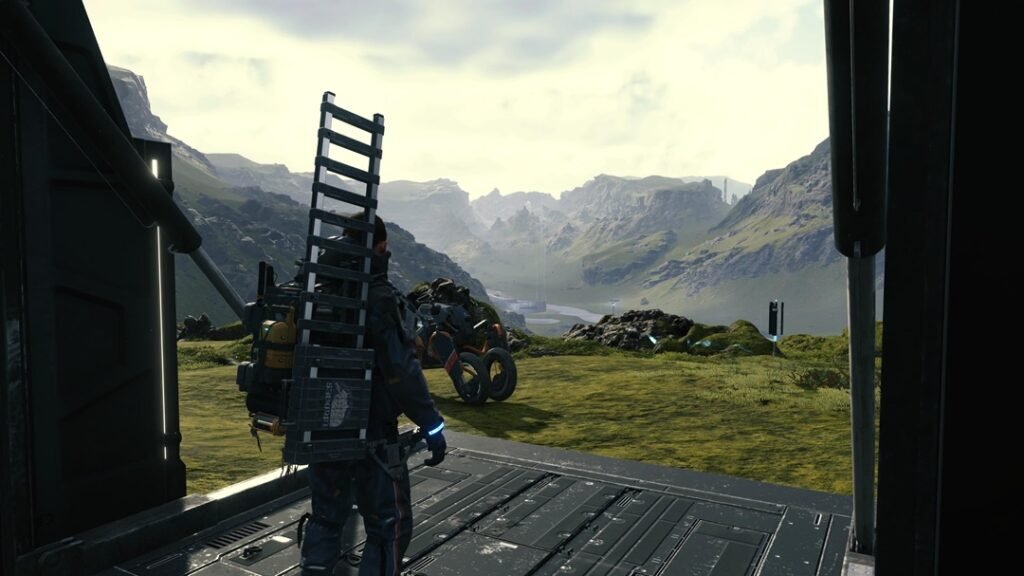
The game actively encourages you to use structures other players have built. See a ladder someone placed on a cliff? Use it. Find a bridge crossing a river? Cross it. Discover a zipline network someone spent hours setting up? Thank them and utilize it. The game rewards collaboration, not isolation.
And it clicked: this is how I should approach all gaming.
Gaming isn’t about suffering alone to prove your worth. It’s not about rejecting help because using a guide somehow diminishes your achievement. Elden Ring would have been so much more enjoyable if I’d allowed myself to look up weapon locations, read build suggestions, watch strategy videos for frustrating bosses. I was making myself miserable for no good reason.
Death Stranding gave me permission to play games differently. To accept that community, collaboration, and outside help don’t make you less of a gamer – they make the experience better.
What Actually Works
Despite all the frustrations, so much of Death Stranding works beautifully. The graphics are stunning – the landscapes, the weather effects, the character models. When Low Roar or other licensed tracks kick in during a perfect moment of traversal, it’s genuinely affecting. The sense of gradually transforming a hostile environment into a connected civilization is satisfying in a way few games achieve.
The gameplay loop, repetitive as it becomes, has a meditative quality. Planning a route, preparing your equipment, executing the delivery, dealing with unexpected challenges – there’s a rhythm to it that becomes almost zen-like. It’s really about strategy and planning infrastructure, managing loadouts and building an efficient network across the landscape.
Worth Playing?
Death Stranding isn’t for everyone, and that’s okay. If you need constant action, tight combat, or straightforward storytelling, you’ll hate it. If micromanagement and repetitive tasks drive you crazy, skip it.
But if you’re burned out on punishing difficulty, if you’re tired of gaming feeling like a constant test, if you want something that makes you think about connection and collaboration differently – Death Stranding might surprise you like it surprised me.
I’m still working toward that platinum trophy. I’m still building roads and ziplines. I’m still making deliveries to annoying NPCs. And I’m grateful this game exists, flaws and all, because it reminded me why I started playing games in the first place: not to prove anything, but to experience something meaningful.
Leave a Reply